

Bush touts threat from Iraq
MANCHESTER, N.H. ? President Bush warned Saturday that Saddam Hussein could strike without notice and inflict “massive and sudden horror” on America, offering a new rationale for pre-emptive military action against Iraq.
In the run-up to key congressional votes on war-making authority, Bush promised in the clearest terms yet to rebuild Iraq after a war. He also said the Iraqi president had a “horrible history” of attacking his enemies first.
“We cannot ignore history. We must not ignore reality. We must do everything we can to disarm this man before he hurts one single American,” Bush told hundreds of cheering police and National Guardsmen. A leading Democrat, Senate Majority Leader Tom Daschle, strongly challenged the “strike first” policy as Bush toured this politically important state.
The president’s remarks reflect subtle changes the White House is making in its case against Saddam as Bush prepares to address the nation Monday night from Cincinnati.
Advisers say the address now in its fifth draft seeks to synthesize the case against Saddam, the reasons war may be necessary and why the threat is imminent.
Bush and his advisers were tinkering with the speech during a weekend stay at his parents’ home in Kennebunkport, Maine. He made a quick visit to New Hampshire to address soldiers and police officers, then headline a $500,000 fund-raiser for GOP Senate candidate John Sununu.
The congressman’s father was White House chief of staff for Bush’s father.
In a state whose motto is “live free or die,” GOP donors jumped to their feet when Bush said of Saddam, “For the sake of peace, for the sake of freedom, for the sake of our future and our children’s future, we will disarm him.”
Bush won agreement last week with a bipartisan group of House leaders for a resolution allowing him to use force against Iraq. Senate Democrat are more skeptical, though a resolution is expected to pass as early as this week.
Support not unilateral
“Pre-emptive strikes are something we have to take very, very seriously and carefully,” Daschle, D-S.D., said Saturday on CNN. “Number one, what kind of a standard does it set for the rest of the world? If it’s OK for us, is it OK for India? How about Russia? How about Israel?”
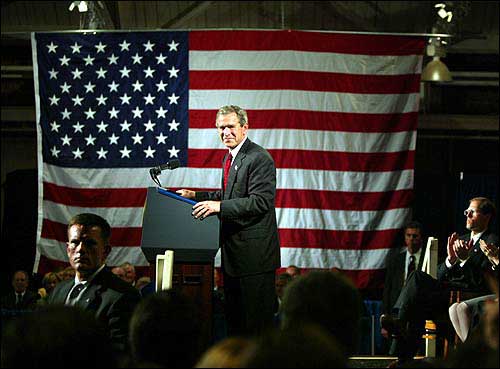
Leading the fight for a GOP Senate, President Bush lends his support to Rep. John Sununu, R-N.H., seated at far right, at a fund raiser in Manchester, N.H. Bush also used Saturday's speech to emphasize the danger Saddam Hussein posed to the United States and other nations.
Daschle said the House resolution gave Bush too much latitude to wage war. He questioned whether there is enough evidence that Iraq poses an imminent threat and said Bush has failed to explain how Iraq would be rebuilt after war.
“How long will we be there? What will it entail, on the part of the United States? How much will it cost? Who will be involved?” Daschle asked.
Bush’s struggle to pass a tough U.N. resolution on Iraq was underscored Saturday when Russian Foreign Minister Igor Ivanov said the return of weapons inspectors to Iraq should not be delayed. Bush wants the mission postponed while he presses for a new U.N. mandate.
“The message to Russia is this is about peace, this is about how to preserve peace, by removing the greatest threat to peace,” White House spokesman Ari Fleischer said, offering a new rhetorical twist likely to be appear in Bush’s Monday address to counter critics who say the president is too hungry for war.
In a preview of that speech, Bush tried in Manchester to address the issues raised by Daschle and other skeptics.
On the question of launching pre-emptive action, Bush laid out his usual case against Saddam: The Iraqi leader produces weapons of mass destruction, consorts with terrorists, oppresses his own people and condones abuses against the wives and daughters of his political opponents.
But then he added a new rationale, suggesting Saddam might strike first if not disarmed.
“The regime is guilty of beginning two wars. It has a horrible history of striking without warning,” Bush said in his weekly radio address.
“Delay, indecision, and inaction are not options for America, because they could lead to massive and sudden horror.”
While other administration officials have talked about efforts to bring democracy and stability to a post-Saddam Iraq, Bush has had little to say about his post-war intentions.
“Should force be required to bring Saddam to account, the United States will work with other nations to help the Iraqi people rebuild and form a just government,” Bush said. Aides said it was his most firm commitment yet, though it came with no details.
Bush said a congressional resolution would help persuade skeptical world leaders to back a tough new U.N. resolution on Iraq.
“I urge Americans to call their members of Congress to make sure your voice is heard,” Bush said.