

More students balk at animal dissection
Increasing numbers of students are asking to opt out of the science class ritual of dissecting frogs or fetal pigs, branding the practice cruel and insisting they can learn as much from computer simulations.
A 16-year-old honor student in Baltimore was removed from her anatomy class last week after refusing to dissect a cat, then allowed back in with the option of computer alternatives after protesters picketed the high school.
In Las Vegas, the Clark County School Board voted earlier this year to let students opt out of dissections if they have parental support.
The new policy was adopted after a petition drive led by eighth-grader Laurie Wolff, an A student who received a C in a science class two years earlier after declining to cut up an earthworm.
Anti-dissection students also appealed for policy changes this year at a school board meeting in Little Chute, Wis.
Little Chute student Amy Richards gave a practical reason for accommodating the dissenters. “They won’t learn much with their eyes closed because they’re disgusted,” she said.
According to the Humane Society of the United States, eight states have approved opt-out policies California, Florida, Illinois, Louisiana, Maine, New York, Pennsylvania and Rhode Island. A similar policy is pending in New Jersey’s legislature.
The Baltimore case illustrates how quickly a teacher’s classroom decision can become the focus of ideological controversy.
On Sept. 23, Jennifer Watson was taken out of her Kenwood High School honors anatomy class and placed in a general science class after she asked for an alternative to cat dissection. The next evening, Humane Society officials attended a school board meeting, requesting that dissection alternatives be provided districtwide.
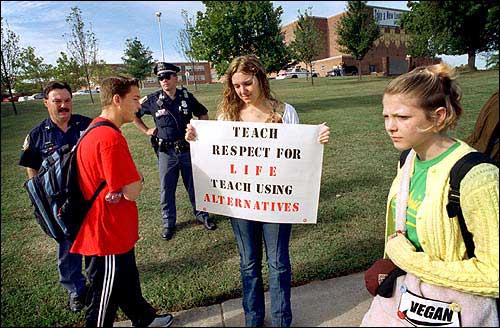
Jennifer Watson, 16, center, a junior at Kenwood High School in Middle River, Md., holds a sign protesting her removal from an Honors Anatomy and Physiology class for refusing to dissect a cat. After the protest last month, Jennifer was allowed to return to her class.
The following day about 20 protesters picketed outside Kenwood High, and school officials announced Jennifer would be allowed back in her class. She will perform computer-simulated dissections, perhaps joined by some other students, while the rest of the class dissects cats.
“I’ve loved animals my whole life,” said Jennifer, whose family has several cats. “I was standing up for what I believe in.”
The Humane Society estimates that 6 million animals mostly frogs, fetal pigs and cats are dissected annually in American schools. The society distributes anti-dissection videos and loans computer software to schools interested in offering alternatives.
“Students and teachers come to us on a regular basis saying, ‘I don’t want to do this any more,”‘ said Lesley King, the Humane Society’s director for education and animal welfare. She said school districts can save money by purchasing reusable dissection software rather than buying dead animals that can only be dissected once.
The 9,000-member National Association of Biology Teachers is wary of the push for alternatives. Although it urges teachers to be sensitive to students’ objections, its formal position says, “No alternative can substitute for the actual experience of dissection.”
The National Science Teachers Assn., which claims 53,000 members, also defends dissection but advises teachers to be flexible.
“There were few suitable alternatives when I taught, but now there are some extremely sophisticated virtual technologies,” said Wendell Mohling, a former biology teacher in the Shawnee Mission (Kan.) school district who is associate executive director of the science teachers group.