

Baker’s Dotson twins count their blessings
Volleyball-playing sisters from Maple Hill grow closer after one grapples with rare form of cancer
Baldwin ? Kendra and Kyla Dotson are two of a kind.
Best friends from birth, the identical twins had no other siblings.
“Just the two of us,” Kyla said.
Kyla is left-handed. She played volleyball, basketball, softball and trumpet at St. Marys High, just west of Topeka. She’s the youngest of the pair, by two whole minutes.
Kendra is right-handed. She played volleyball, basketball, softball and french horn. She’s the “tell-it-like-it-is” twin, according to their mother.
Their interests are as identical as they are, and they’re seemingly never apart.
“We had spent, like, one night away from each other,” Kyla said.
Both were decorated athletes, good students, devout Christians and typical teenagers. Boyfriends, sports, friendships ” everything you’d expect from two girls in their high school years ” was all pretty normal.
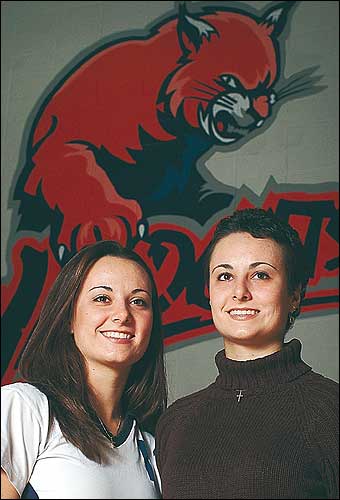
Kyla Dotson, left, and twin Kendra pose beneath the Baker mascot. The twins are scholarship athletes on the volleyball team, but Kendra has been unable to play this year due to the discovery, removal and treatment of a cancerous germ-cell ovarian tumor.
Until Feb. 25, 2002.
The two had signed letters of intent to play volleyball at Baker University early in their senior year. They didn’t know what they wanted to do with their lives, but business seemed like a good major. And they would play volleyball for the Wildcats.
It seemed that everything was going so smoothly for Kendra and Kyla Dotson last winter. Neither could have guessed what they would go through before departing for Baldwin.
They couldn’t have guessed how it would change them, and how it would bring them closer to their faith, to reality, and to each other.
“All through high school,” Kendra said, “you think, ‘Hey, nothing can happen to us.'”
“A Slap in the Face”
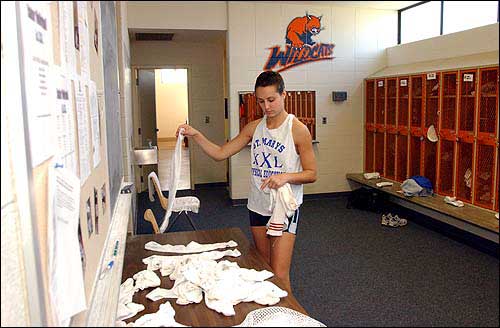
Kendra Dotson sorts socks in the women's locker room at Baker University after having washed and dried the Wildcats' volleyball team laundry. Dotson participates with the team in the role of a manager.
Kendra had played basketball for her first three years of high school. She decided not to play her senior year, though Kyla still had the passion.
Kyla was finishing a stellar basketball career at St. Marys, ready to lock up all-league honors in her third sport ” she already earned all-league in volleyball and softball.
Kendra, meanwhile, continued playing offseason volleyball, and was preparing for softball season in the spring.
She had worked so hard to be one of the top pitchers on a strong Bears squad ” which annually contends for the Class 3A state title. This year would be no different, and Kendra wanted nothing more than to contribute to it before saying goodbye to softball and going on to play volleyball for Baker.
“I was really looking forward to it,” Kendra said.
But something bizarre started happening. Her stomach started hardening. It became tougher to compete.
Kendra had just had a sonogram in December. It found nothing. Kendra is a self-admitted hypochondriac and wondered if she was inventing the pain in her stomach.
A volleyball tournament in late February was the final straw. In warm-ups, Kendra tried running. She couldn’t. She tried jumping. No luck. It was too hard. She couldn’t play that day, instead giving into the pain and going home.
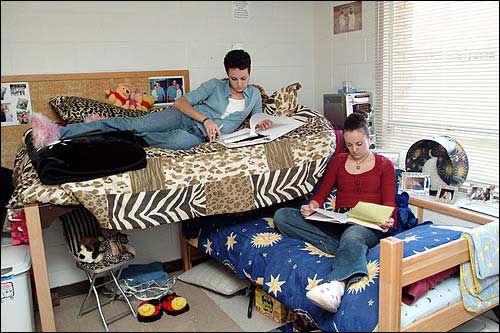
Kendra, left, and Kyla Dotson attack their homework in the comfort of their dorm room at Baker University.
“The next morning I went to the emergency room,” Kendra said. “That’s when I found out what it was.”
The doctors at Stormont-Vail in Topeka found a tumor, about the size of a watermelon, in her lower stomach. She immediately went into surgery, on Feb. 25, to remove it.
“When I had the surgery, they said there was only a 10 percent chance that it was cancer,” Kendra said. “So I went into surgery and didn’t think anything of it.”
It was cancer.
Germ-cell ovarian cancer ” one of the rarest forms of cancer ” had attacked Kendra’s body. There were no symptoms, just a rapid-growing tumor.
The news was devastating. Not just to Kendra, but to her whole family, including Kyla, her twin sister.
“It was a slap in the face,” Kyla said. “I realized that I might have to live without her. I didn’t know if I could.”
As with anyone stricken with one of the most feared illnesses in the world, hundreds of questions raced through Kendra’s overwhelmed mind. Did it spread? Would it come back?
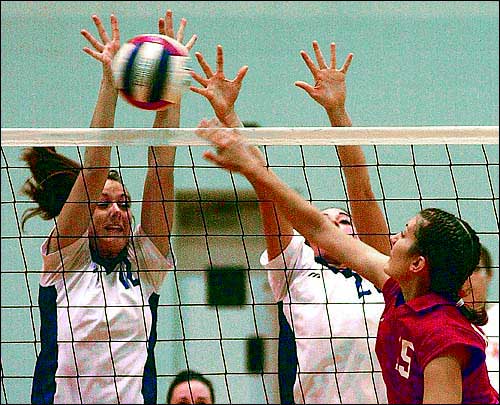
Baker's Kendra Dotson, left, and Sarah Douglass block a hit by Mid-America Nazarene's Lisa Koehn during a junior varsity match earlier this season at Baker.
Kendra tried her best to keep her cool. She had to, and she knew it.
“I couldn’t let it get to me,” she said. “If it got to me, it would get to everyone else worse.”
The Road to Recovery
Softball was now out of the question for Kendra. Recovering from cancer is a long, painful process. Chemotherapy treatments would replace batting practice. Blood tests took priority over perfecting her fastball.
All along, Kyla had to keep going. She assumed her position at first base. But she felt so bad.
“At times, it was like, ‘I deserve it, not her’,” Kyla recalls. “I thought, ‘She’s such a better person than me.'”
The Dotsons hail from a small town in central Kansas called Maple Hill. It’s about 10 miles from where they went to high school, and the population doesn’t exceed 500 or so.
Kendra’s story captured the hearts of the Maple Hill community, and they came in droves to support the fight for Kendra’s life.
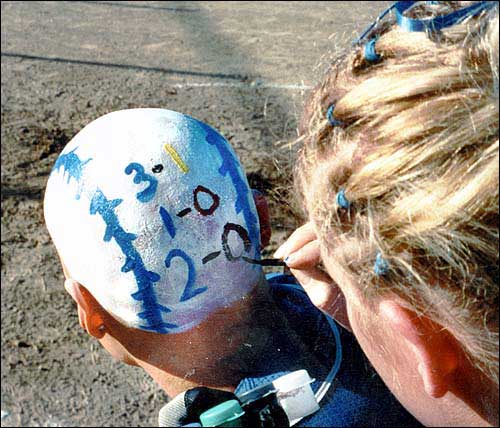
Kendra Dotson refused to get down about her cancer diagnosis. One way she kept her spirits up was to paint her head like a softball and allow friends and teammates to keep score on the back of her head as she did for her St. Mary's softball team in the state tournament last spring.
“She didn’t know a lot of it, because she doesn’t remember how many people showed up,” Kyla said. “Our whole school signed a giant banner. Everybody from our town sent her something.”
Added Kendra: “In the hospital, people would walk in with flowers, and they’d be like, ‘Her room is that way.'”
The final count had 72 roses, 46 stuffed animals, 14 potted plants and countless prayers for a successful recovery. Kendra claims to this day that it was her Christian faith that made survival possible.
“The only way I got through it was God,” she said. “Everyone prayed for me. I got letters from people in different states who were praying for me. I was on about 30 churches’ prayer lists. It was the best.”
Chemotherapy treatments started almost immediately, after a CAT scan detected that the cancer had hit her liver. For three grueling months, Kendra had to go to St. Luke’s Hospital in Kansas City to wipe the cancer out of her body.
The road to recovery was tough on everybody.
“It’s the hardest thing I’ve ever been through,” Kyla said. “You don’t expect anyone around you to get sick. Especially your twin sister.”
All along, Kendra kept her composure. Her 5-foot-9 body weakened, her weight dipped to 113 pounds. Her hair fell out, but Kendra tried her best to keep a positive attitude.
“I didn’t know if I was going to die or not,” she said. “Hair was the last thing I worried about.”
After the first treatment, Kendra’s hair started coming out in clumps. It was time to shave it, and Kendra did so ” without telling her sis.
“She didn’t warn me,” Kyla said with a smile. “I came home one day and walked in the house and she said, ‘Hi,’ and she had no hair. I screamed.”
Kendra said her altered appearance was a tough obstacle, but not nearly as tough as what she was already going through.
“Hair isn’t that important. It’s going to grow back,” Kendra said. “People still loved me, and they still told me I was beautiful.”
She paused and laughed.
“They were probably lying to me, but they still told me that.”
Time for Reflection
After three months of excruciating chemotherapy sessions, Kendra was cancer-free. She was able to graduate with her class and was able to watch Kyla lead St. Marys to the Class 3A state softball tournament.
“Right before the championship game,” Kendra said, “instead of saying, ‘Lady Bears,’ they said ‘We love Kendo!'”
When the state title game rolled around, Kendra was in attendance, with her bald head painted like a softball. As runs came across the plate, score was kept on her head.
St. Marys took the 3A state crown ” and dedicated it to Kendra.
“The coach was great about it,” Kendra said. “They saved me my uniform so I could wear it to all the games.”
Now, Kendra and Kyla share a dorm room at Irwin Hall on the Baker University campus. Life is getting back to normal, though it’s not quite there yet. While Kyla was able to play volleyball this season, Kendra had to settle for being team manager.
She’s still too weak to compete. She works out on her own, a slow process, but one that will take her back to the court alongside her twin sister before much longer.
“I’m afraid to start volleyball again,” Kendra admits. “My stomach is never going to be as strong as it was. It’s going to be hard for me to get back into shape.”
Once a month, blood is taken and tested. As long as the Alphafetoprotien levels stay down, the cancer stays away.
Every three months, Kendra meets with doctors, where a CAT scan is taken. The chances of recurrence are there, but chances are, Kendra’s worst days are behind her. She can now start living again, like a normal 18-year-old college freshman.
“It gives you a new perspective on what’s really important,” she says. “I’m really thankful that I’m alive. To go outside and see the leaves on the trees : it’s just amazing to me.”