

Operation WildLife faces budget crunch
Operation WildLife is on the financial ropes, jeopardizing the life-saving care the organization provides raptors, migratory birds and other orphaned animals.
Donations to the wildlife rehabilitation facility near Eudora have been dwindling, its founder said Tuesday. At the same time, the number of animals in the agency’s care ballooned after federal officials suspended licenses of WildCare, another area rehabilitator, and moved its animals to Operation WildLife.
“Financially, this is killing us,” said Diane Johnson, who started Operation WildLife 10 years ago.
“We’re between a rock and a hard place. I don’t want the animals to suffer because we can’t pay the bills. It’s dire.”
Operation WildLife is exhausting its resources caring for its regular array of orphaned animals in addition to the hawks, falcons, kestrels, owls and a turkey vulture taken into protective custody three months ago by the U.S. Fish and Wildlife Service.
Operation WildLife receives no compensation from the government to care for the raptors confiscated from WildCare, a rehabilitation organization east of Lawrence.
WildCare had its two federal licenses suspended in September for mishandling the birds and failing to comply with record-keeping requirements, Fish and Wildlife officials said.
Johnson said animals from WildCare could be euthanized if money couldn’t be found to pay for their care and treatment.
Overall, Johnson said she was spending $800 a week to feed animals at Operation WildLife. Some animals from WildCare also have required extensive medical treatment, she said.
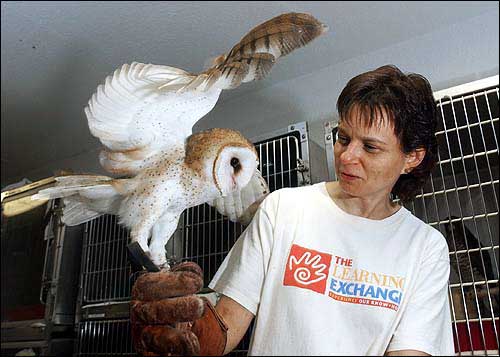
Mary Friedl, a volunteer at Operation WildLife, Linwood, exercises a barn owl at the animal rehabilitation center. Recently the organization took on additional animals from WildCare, which had its license suspended by the U.S. Fish and Wildlife Service. The added load is straining Operation WildLife's resources.
“Our priority is to help the animals, but we didn’t get any financial help,” she said. “It’s a Catch-22 for us. I can tell Fish and Wildlife we can’t handle it. They’ll come and get them, but I’ll know I’ve condemned them to death.”
Attempts Tuesday to reach WildCare staff were unsuccessful.
Johnson said she was trying to place a great-horned owl, turkey vulture and a barn owl from WildCare that cannot be released into the wild at facilities in other parts of the country.

 Feds pull WildCare permits (9-12-2002)
However, that effort is hindered by WildCare’s recent appeal of its federal license suspensions.
Janell Suazo, chief of the migratory bird permit office of the U.S. Fish and Wildlife Service at Denver, said WildCare was banned from rehabilitating migratory birds and from possessing them for educational purposes until the case was settled.
Suazo said the appellate process in this case may not be resolved quickly. That leaves legal claims to rightful possession of the birds in limbo, she said.
Meanwhile, Operation WildLife’s financial problems grow.
“I’m frustrated by the whole thing,” Johnson said. “We have absorbed the entire impact of this.”
| For information about donating money or volunteering at Operation WildLife, call (785) 542-3625 or write to the organization at 23375 Guthrie Road, Linwood 66052. |
Johnson said Operation WildLife’s winter food supply was gone. The animals from WildCare consumed about half that reserve.
In addition to seeking an infusion of funds, Operation WildLife also is sounding the call for volunteers.
“If they want to volunteer, we have an extra workload,” she said. “We need people who want to help animals.”