

Inspectors take up position in Iraq
Amman, Jordan ? Big things – war and peace – hang in the balance as U.N. weapons teams take up the hunt again in Iraq. But it may be small things – the gauge of a metal tube, the soft beep of a detector, a telltale whiff of chlorine – that will tip the balance in the end.
The inspectors, who began arriving Monday in Baghdad, may face months of painstaking analysis to try to answer a core question: Has Iraq, in four years without international inspections, secretly continued to develop doomsday weapons?
The Iraqi government says flatly it has not. To test the truth of that, the U.N. experts are equipped with satellite photos and defectors’ accounts, inventories of Iraqi equipment purchases and the latest in high-tech detection gear.
They have a confidential list of 700 to 800 potential inspection targets – sites possibly associated with nuclear, chemical or biological weapons. They know, from the previous U.N. inspectors’ experience, they’ll work long days that often will begin with surprise pre-dawn calls on remote sites and end with hours at the computer or the laboratory table.
Before landing in Baghdad, the chief U.N. weapons inspector, Hans Blix, said the specialists – eventually numbering hundreds – would try to check out sketchy reports of Iraqi “mobile labs” for biological weapons, and of new underground storage sites.
Mohamed ElBaradei, the head of the International Atomic Energy Agency that seeks out nuclear weapons, said he had leads to conduct a thorough search.
“We have lots of information about where to go,” he said. “We have a very good game plan.”
Teams from ElBaradei’s agency were the most clearly successful in the inspectors’ previous stay. They uncovered and demolished extensive facilities built in the 1980s to develop atomic bombs, including a prize find 20 miles south of Baghdad, a complex where gas centrifuges were tested – machines that “enrich” uranium as bomb material.
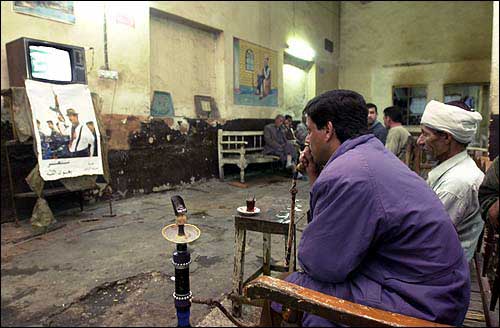
Iraqis watch the evening news at a tea house in Baghdad, Iraq. U.N. chief weapons inspector Hans Blix arrived Monday in Iraq with an advance team. The inspectors met with Iraqi officials Monday as they prepared to resume the search for weapons of mass destruction, a mission that could determine whether Iraq is plunged into a new war.
New satellite photos show rebuilding at that site, Al Furat, since U.N. inspectors pulled out of Iraq in December 1998. In addition, the CIA says the Iraqis have tried to import aluminum tubes of a strength and dimensions that might be used in centrifuges.
The U.N. teams hunting for longer-range missiles in the 1990s also were relatively successful, reporting they could account for destruction of all but two of Iraq’s 819 missiles capable of reaching beyond 90 miles, a limit set by the U.N. Security Council after Iraq’s defeat in the 1991 Gulf War.
A recent U.S. intelligence report speculated the Iraqis might actually have a dozen or so of these old models, assembled from odd, unaccounted-for parts.
The U.S. report also suggests they may have resumed developing new longer-range missiles, since reconnaissance photos show rebuilding at a plant :quot; destroyed by U.N. teams – that was to produce solid propellant for such missiles, and a new engine test facility at another site.