

Journalist peeks in Saddam’s e-mail
DURHAM, N.C. ? Even Saddam Hussein gets spam.
He also gets e-mail purporting to be from U.S. companies offering business deals, and threats, according to a journalist who figured out a way into an Iraqi government e-mail account and downloaded more than 1,000 messages.
Brian McWilliams, a free-lancer who specializes in Internet security, said he hardly needed high-level hacking skills to snoop through e-mail addressed to Saddam.
While doing research late one October night, the Durham resident clicked on the official Iraqi government Web site, http://www.uruklink.net/iraq.
The site, which worked last week but was offline Sunday, included links that allow visitors to send e-mail to Saddam and allowed users of the government-controlled site, which is hosted in Dubai, to check their own accounts.
That mail-checking feature caught McWilliams’ eye. On a whim, he typed in the address for Saddam, “press@uruklink.net,” using “press” for president, and tried “press” again as a possible password.
Then he waited while his data bounced around the world.
“It took a long time. I was about to hit stop, but then, boom! The inbox appeared,” said McWilliams.
There’s no way of knowing if Saddam ever received any e-mail addressed to him. The messages that filled McWilliams’ screen were sent between mid-June and mid-August, when the mailbox apparently reached capacity. None of them had been read or replied to, McWilliams said.
“Whoever was responsible for checking the mail – I’m sure it wasn’t him – had fallen behind,” he said.
The most disturbing messages appeared to be business proposals from American companies, despite U.S. prohibitions against such transactions, McWilliams said.
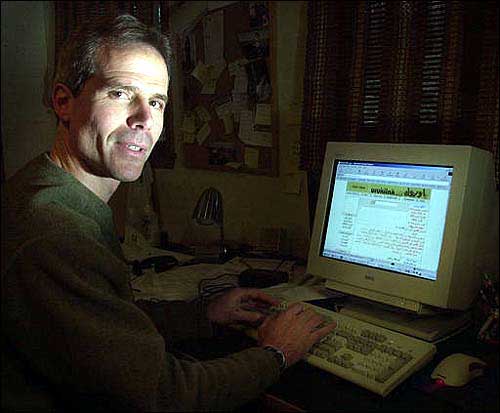
Brian McWilliams, a free-lancer who specializes in Internet security, hacked into an e-mail address where Saddam Hussein takes public comment. McWilliams said it was easy to access the account.
The CEO of a California wireless technology company e-mailed Saddam to request a meeting, suggesting they could discuss “technology improvements and exporting of rich technology abroad,” McWilliams said.
He said the company, which he did not identify, claimed to have developed wireless technology capable of “igniting large sections of the atmosphere.” But when McWilliams called the company he was told it contacted Saddam only to get permission to put a communication antenna in Iraq.
He also found interview requests from journalists and obscene messages from angry Americans. One man who identified himself as a former U.S. paratrooper wrote that he would welcome an invitation to finish what he started during the Gulf War.
But the account also attracted admirers, including someone writing from Austria who called Americans arrogant and told Saddam that if the United States attacked Iraq, “you need only send a ticket and I will come to Iraq to fight Americans.”
Some requested signed photographs.
“I didn’t realize how many autograph-seekers there are out there,” McWilliams said. “I guess they all just want to score the big dictator.”
McWilliams said some writers may have been inspired by a Pennsylvania man who wrote to Saddam shortly after the Sept. 11 terrorist attacks and received a lengthy reply offering condolences to the victims.
McWilliams said he e-mailed Iraqi officials about his actions and recommended that they change the password, but heard nothing back.