

Schools offer full range of services
BENNINGTON, VT. ? Wander down a certain hallway at Molly Stark Elementary School, and before you see it your nose will know it’s there: The air is sweet, antiseptic, a bit minty.
It’s . . . a dentist’s office?
In this sleepy southern Vermont town, nearly half the school’s 400 students visit dentist Michael Brady regularly.
“They go to gym, they go to reading, they go to the dentist ” it’s all the same to them,” Brady said.
At a time when schools are being asked to focus on academic essentials more than ever, a small but growing number are embracing the radical idea of a “full-service” school: one that doubles as a place for community medical and dental care, exercise, family counseling ” even wedding receptions.
Besides meeting their students’ needs, such schools are opening their doors to folks who wouldn’t ordinarily set foot in a public school and finding new ways to extend services for students with after-school needs.
Molly Stark’s dental clinic was logical in a rural area where many low-income families never visit the dentist, and then only after their children’s teeth have become badly decayed, said Principal Sue Maguire.
Some students as old as 10 had never sat in a dentist’s chair before doing so at school. Maguire recalled talking to one student who, after having several rotten teeth extracted, said he had never known what it was not to be in pain.
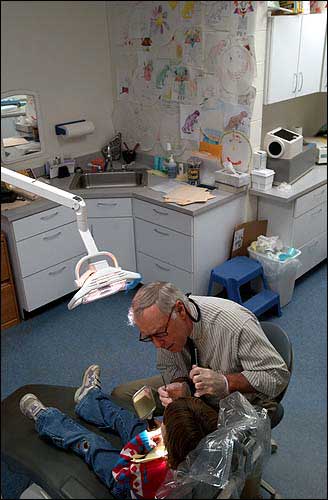
Dr. Michael Brady does a fluoride treatment on a kindergartner in his school dentist office at the Molly Stark Elementary School in Bennington, Vt. Nearly half the school's 400 students visit Brady regularly. Molly Stark Principal Sue Maguire said the dental clinic was logical in a rural area where many low-income families never visit the dentist.
“We were really doing what seemed to be the right thing to do for families, to create successful learners,” she said.
The approach seems to be working. Molly Stark, one of about 30 schools flagged last spring by state officials as “needing improvement” under President Bush’s education plan, this fall came off that list when test scores improved.
Maguire, who has been at Molly Stark for 26 years, also said she was “doing less crisis intervention” since bringing in a preschool program, a consulting pediatrician and part-time psychologist, mentoring, before- and after-school care, parenting classes and a center for family counseling.
“You can pull a poor school up … if you give the kids what they need to do well,” Maguire said.
Schools in New York, Boston, Chicago and Portland, Ore., have brought in similar services, generally with the help of local nonprofit groups.
In New York, a handful of full-service schools provide a mix of medical and dental care, parenting courses and even help for pregnant women. A few stay open on weekends, providing sports, arts and other recreation programs.
 ¢
¢ In Boston, one school holds after-school English sessions for immigrant parents. Such programs are available elsewhere, but often have long waiting lists, said Matt LiPuma of The Home for Little Wanderers, a Boston child-welfare agency that works with 35 schools.
At an elementary school in Iuka, Miss., the auditorium serves as the community’s performing arts center. The library is open to the public, and families book the school for wedding receptions in the center courtyard. The gym opens its doors to adults who want to work out after school.
The model has been catching on only slowly nationwide, said Joy Dryfoos, a New York sociologist who has been pushing the full-service idea for decades.
“If principals were taught how to do this, they could do a lot more than they’re doing,” she said. “They just don’t realize it’s out there. They’re under so much pressure to perform.”