

1950s modernism now historic
Savannah, Ga. ? For sightseers who visit Savannah to lose themselves in the 19th-century ambiance of antebellum mansions and oak-shaded squares, Drayton Tower packs a jolt.
Rising above its red-brick and wrought-iron surroundings, the 12-story concrete box with ribbons of green windows stands out like a steering wheel on a horse-drawn carriage.
Drayton Tower was billed as “ultramodern” when it opened in 1951. It had heat-absorbing windows and faucets that dispensed ice water. Unlike any other apartment building in Georgia, it had central air conditioning.
Its culture-clash design, now marred by soot stains and cracked windows, makes it a building Savannahians love to hate. Many call it an eyesore that detracts from the city’s Old South charm.
But Drayton Tower now has something in common with its older neighbors: The city declared in August that at 51 years old, the tower is a historic building.
The Drayton Tower case is part of one of the hottest debates in historic preservation: How much of postwar modernism is worth saving?
The bold shift in architecture after World War II favored stark, boxy facades of unadorned raw materials. Half a century later, many consider them positively ugly.
But more preservationists are taking up modernism’s cause for what it tells us about American life in the 1950s ” a time when people looked optimistically to the future, constructing buildings that looked ahead of their time.
To gauge modernism’s worth by today’s standards of taste is wrong-headed, says Wendy Nicholas, Northeast director of the National Trust for Historic Preservation.
“People of my parents’ generation just railed against Victorian buildings as ugly, not worth saving,” Nicholas says.
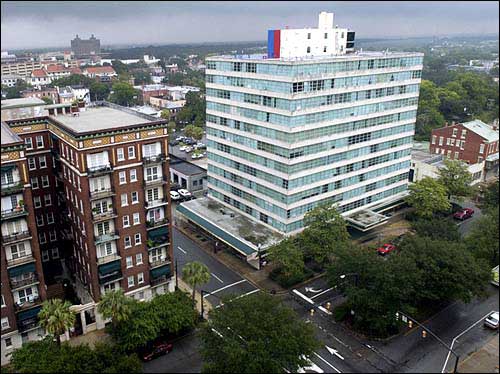
Drayton Tower, right, was billed as ultramodern when it opened in 1951 in Savannah, Ga. Although many residents consider the building an eyesore that degrades the city's Old South charm, the Drayton has been declared a historic building.
New York’s Lever House, a 1952 skyscraper of stainless steel and glass, was listed on the National Register of Historic Places in 1983.
As more modern buildings reach their 50th birthday ” generally the minimum age for historic status ” preservationists face the irony of saving architecture their movement once considered its enemy.
When it opened in 1951, Drayton Tower was meant to be a signpost to Savannah’s future, a shining example of how technology made life easier at a time when many homes still had outhouses.
Over the front doors jutted a canopy of reinforced concrete that seemed to levitate 15 feet over the sidewalk. Elevators were self-service. Bathrooms had an extra faucet for “running ice water.”
“Savannahians never saw anything like it before,” the Savannah Morning News wrote on June 10, 1951.
But Drayton Tower is no longer upscale. Cheap rent makes it popular with college students. Replaced windows do not match the original shade of green.
“It has to be the most reviled building in the city,” says Robin Williams, head of the architectural history department at the Savannah College of Art and Design.
Williams says Drayton Tower is important because it has retained something prestigious cousins in New York and Chicago have lost ” shock value.
“You’ve got this stridently modern building” at the center of quaint Savannah, Williams says. “It’s a pure artistic statement, whether you like that statement or not.”