

Coal town mines tourist possibilities
Lynch, Ky. ? Years ago, Bob Lunsford toiled in the depths of a dark and grimy Appalachian coal mine, hardly the kind of place people would pay money to see.
Now he’s a guide for thousands of tourists from around the world who come to Harlan County to peer into the abandoned mine that once was the economic lifeblood for this coal company town.
And next year, tourists if they dare will be able to travel inside Portal 31 to see exhibits showing the transformation of the industry from the picks, shovels and ponies of the early 1900s to the powerful digging machinery used today.
“People have heard so much about coal mining that they want to go in and see it for themselves,” said Lunsford, who worked 42 years in and around the mine in the eastern Kentucky town of Lynch. “It was very hard, very nasty work. You would have roof falls. A lot of people got killed in these mines. It was dangerous.”
When the last miner left the played-out mine a decade ago, the Appalachian coal town’s fate seemed sealed. The economy hit rock bottom and has yet to rebound.
Local leaders searching for a solution looked again to the mine, a seam that runs under tons of rock from a mountain above. Tourists would walk about 1,200 feet into the mine.
Bruce Ayers, president of Southeast Community College in nearby Cumberland and head of a committee that oversees the Portal 31 project, said he believed tourists would flock to Lynch and other Harlan County communities to experience life in a historic coal town.
Coal mines, copper mines, even salt mines have been opened to tourists in other areas, but few of them in a place as romanticized as Harlan County, where the crushing burdens on coal miners were depicted in the 1976 Oscar-winning documentary “Harlan County, USA,” an account of a violent 1974 strike.
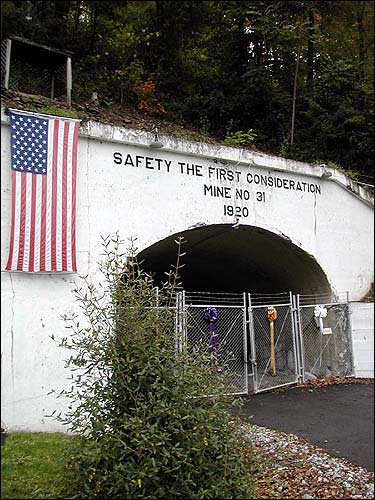
Gates close the entrance to Mine No. 31 in Lynch, Ky., the abandoned mine that once was the economic lifeblood for the coal company town. Next year, tourists will be able to walk inside Portal 31 to see exhibits showing the evolution of the industry.
Lynch was a bustling town in its heyday, with about 10,000 people from 30 countries living here. Now, the population is little more than 1,000. Nearby Benham, hit just as hard as Lynch by mine closings, has turned an old company school into an inn, and a former store into a coal mining museum to try to capitalize on tourism.
The effort is beginning to pay off. About 30,000 people visited the museum this year, and Lunsford expects just as many to pay $5 each for the half-hour tour of the coal mine when it opens, perhaps as early as June.
Lexington mining engineer Steven Gardner was responsible for ensuring the mine poses no risk to tourists.
That meant limiting tours to only the sturdiest half-mile section of the mine, installing a super-strength wire mesh across the ceilings to keep rocks from falling, and drilling double the number of 4-foot bolts into the overhead rock to hold it in place.
Also, tunnel walls have been covered with a sealant to permanently bind the coal and rock in place. And contractors sealed off unused mine tunnels to keep methane gas out.
The final safety measure will be an enclosed rail car that will take tourists through the mine. The reinforced top will be strong enough to withstand any rock falls.