

Missile strike in Yemen doesn’t change U.S. opposition to tactic in Israel
Washington ? The Bush administration renewed its opposition Tuesday to Israel’s assassination of terror suspects, even after a U.S. missile killed a top al-Qaida operative and five other people in his car in Yemen.
Sunday’s strike in Yemen was the first such overt attack outside Afghanistan and could signal a new U.S. strategy against anti-Western terrorists.
Israel, which pioneered targeting militants for assassination, sometimes also killing and injuring civilians in the attacks, has been admonished publicly and regularly by the State Department for the tactics.
On Tuesday, while declining to discuss the U.S. operation in Yemen, spokesman Richard Boucher said, “Our policy on targeted killings in the Israeli-Palestinian context has not changed.”
Suggesting the two situations were not comparable, Boucher said, “The reasons we have given do not necessarily apply in other circumstances.”
While criticizing Israel for targeting suspected Palestinian terrorists, the State Department usually has suggested the preferred approach would be to some form of prosecution.
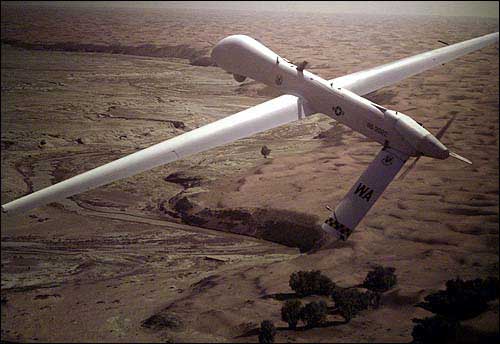
An Air Force RQ-1 Predator like this was used to launch a missile that killed six al-Qaida suspects in Yemen. The United States condemns assassinations of Palestinians by Israel, yet insists Sunday's strike was not a comparable action.
For the most part, the State Department worries that assassinations contribute to a cycle of violence.
The U.S. assassination of Qaed Salim Sinan al-Harethi and five of his associates Sunday in northwestern Yemen drew criticism from Swedish Foreign Minister Anna Lindh.
“If the U.S.A. is behind this with Yemen’s consent, it is nevertheless a summary execution that violates human rights,” she said.
“If the U.S.A. has conducted the attack without Yemen’s permission, it is even worse. Then it is a question of unauthorized use of force,” Lindh said during an official visit to Mexico. “Even terrorists must be treated according to international law. Otherwise, any country can start executing those whom they consider terrorists.”
U.S. counterterror officials say al-Harethi was al-Qaida’s chief operative in Yemen and a suspect in the October 2000 bombing of the destroyer USS Cole.