

Financier pleads guilty in $200 million scam
New Haven, Conn. ? Martin Frankel, the financier accused of looting insurance companies of more than $200 million and using it to live like an outlaw Hugh Hefner, pleaded guilty Wednesday to pulling off one of the most brazen swindles Wall Street has ever seen.
Frankel, 47, could get up to 150 years in prison and $6.5 million in fines at sentencing next year, though federal prosecutors said they will probably give him a break if he helps recover the missing money.
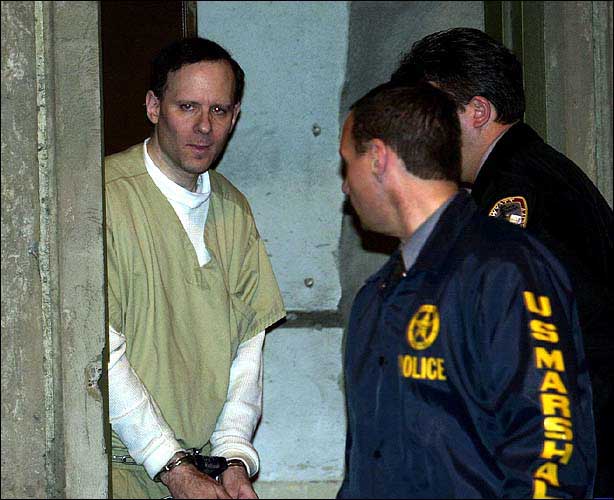
Martin Frankel, the financier accused of stealing more than 00 million from insurance companies, is escorted from U.S. District Court in New Haven, Conn. Frankel pleaded guilty Wednesday to 24 federal corruption charges.
Defense attorney Jeremiah Donovan admitted the government had a “ton of evidence” against Frankel.
“I sure hope he’s a free man one day,” Donovan said.
A pale and gaunt Frankel politely answered “yes” or “no” as he was led through the plea bargain by the judge. Originally charged with 36 counts, he admitted to 24 charges of fraud, racketeering, conspiracy and other offenses.
Prosecutors set the total loss in the fraud at $208 million. To date, the government has recovered $70 million to $80 million, including $30 million Frankel told authorities was hidden in a Swiss bank account.
“The book is not closed in this case,” U.S. Atty. John Danaher said afterward. “Those involved in it should not rest, because we won’t.”
The case went public on May 5, 1999, when firefighters went to Frankel’s Greenwich estate and found a blazing file cabinet and two fireplaces stuffed with burning documents.
Among the papers, authorities said, was a to-do list with “launder money” listed at No. 1. Also discovered was an astrological chart intended to answer the question, “Will I go to prison?”
Four months later, after an international manhunt, Frankel was captured at a hotel in Hamburg, Germany, with nine fake passports and 547 diamonds. He was returned to the United States last year.
Frankel began cultivating his image as a brilliant money manager as he worked out of his parents’ home in Toledo, Ohio. Authorities said he had dropped such names as Lee Iacocca and Walter Cronkite to dupe investors across the country.
Frankel was accused of gaining control of small insurance companies in Missouri, Arkansas, Mississippi, Oklahoma and Tennessee and stealing cash from the company reserves. The FBI said he had put the money in banks around the world.
He ran the scam from a two-mansion compound in Greenwich that he turned into a warren of offices with more than 80 computers and wide-screen televisions tuned to financial news channels. BMWs and limousines came and went at all hours, and armed bodyguards were posted outside.
The 6-foot, 135-pound Frankel had a bevy of women living in one of the mansions. Some were former lovers who, once relegated to ex-girlfriend status, stayed on to work at the securities brokerage Frankel ran out of the other mansion.
One woman who was drawn to Frankel through a personal ad, Frances Burge, hanged herself at the compound in 1997 at age 22. Frankel told police he had decided not to have sex with her because she was overweight.
Three others charged in the indictment are awaiting trial: aides Mona Kim and Sonia Howe, and accountant Gary Atnip. Another aide, German national Kaethe Schuchter, is wanted by the FBI.
Emilio Colagiovanni, an Italian monsignor with Vatican connections, is also accused of trying to use his connections to launder stolen insurance company money through a bogus charity Frankel set up. He is charged with fraud and conspiracy and is living with a cousin in Ohio while he awaits trial.
Insurance regulators from several states are seeking more than $600 million in damages from Frankel in civil cases, and have also sued the Vatican, alleging the church was involved in Frankel’s schemes. The Vatican has denied that.