

Israel vows more attacks
Jerusalem ? Israeli Prime Minister Ariel Sharon said Sunday he is prepared to end Yasser Arafat’s confinement in the West Bank and negotiate with the Palestinians on a truce but with violence at its worst levels in 17 months of fighting, he stressed he will not call off the army offensive against militants.
Sharon said Palestinian security forces had arrested the fifth and final suspect in the October slaying of Israeli Cabinet minister Rehavam Zeevi, fulfilling the condition for lifting a blockade that has kept Arafat under virtual house arrest in his compound in Ramallah in the West Bank since December.
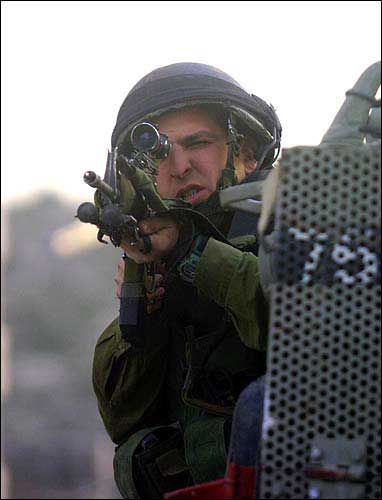
An Israeli soldier trains his scope near the Dheisheh refugee camp, outside Bethlehem in the West Bank. Israeli troops moved into the area two days ago as part of a new offensive, which Israel says is aimed at rooting out militants.
“People have been arrested. I demanded their arrest and their imprisonment,” Sharon told a group of disabled war veterans. “I have said that after they are arrested we shall let him out of there.” He did not say when the Palestinian leader would be allowed to move about freely.
Sharon spoke hours after Israeli helicopters pounded Arafat’s Gaza Strip office to rubble, retaliation for a Palestinian suicide attack that killed 11 others near Sharon’s Jerusalem residence. The Palestinian office in Gaza City had been evacuated before the helicopter attack, and no one was hurt.
“We are in a war,” Sharon told his Cabinet at its weekly meeting Sunday, before he said he was ready to lift the travel ban on Arafat. “All of us must stay united and make every effort to stand up to this wave of terror.”
Late Sunday, a Palestinian opened fire at a Jewish celebration in the coastal city of Ashdod, seriously wounding a 16-year-old boy, police said. They said a suspect from the West Bank was captured. In scattered clashes in the West Bank and the Gaza Strip, three Palestinians and one Israeli were killed.
Early Monday, Israeli tanks, armored vehicles and troops entered the West Bank town of Qalqilya and destroyed a police post, residents said. The Israeli military had no immediate comment.
Sharon’s concession on Arafat came ahead of renewed U.S. diplomatic efforts. The United States is pressing for a cease-fire, and U.S. Mideast envoy Anthony Zinni is to visit the region this week for his third attempt in recent months to work out a truce.
“He’s going to stay in the region and fight his way through this,” Secretary of State Colin Powell said Sunday on CBS’s “Face the Nation.” “We’re not going to allow acts of violence to stop Gen. Zinni from doing his work.”
Vice President Dick Cheney, meanwhile, was heading Sunday to the Middle East for a visit to nine Arab nations Bahrain, Egypt, Jordan, Kuwait, Oman, Qatar, Saudi Arabia, the United Arab Emirates and Yemen as well as Israel, Britain and Turkey.
Sharon has dropped his demand for a week of complete calm before talking about a cease-fire, but made clear the current Israeli military offensive will press ahead.
“We want to make every effort to achieve a cease-fire,” Sharon said. “At the same time, we are continuing with our operations … and if the terror continues our operations will continue.”
In Egypt, Saudi Arabia’s Foreign Minister Saud al-Faisal offered Israel “complete peace from Arab nations” in exchange for Israeli withdrawal from Arab lands captured in 1967, and the creation of an independent Palestine with Jerusalem as its capital.
Al-Faisal offered the most detailed Saudi comments on the kingdom’s overture to Israel since it was first made public last month. Israel has expressed strong reservations, but said it is willing to explore the proposal.
Palestinians said the Jerusalem bombing and a shooting attack at a seafront hotel in Netanya, both on Saturday night, were a consequence of Israel’s stepped-up military campaign. Recent Israeli raids in several refugee camps have resulted in many civilian casualties.
“This is the normal response from the Palestinian resistance for all the Israelis have done in the refugee camps, to Palestinian civilians, women and children,” said Ahmed Abdel Rahman, a top adviser to Arafat. “The Israelis have to expect such operations whenever they escalate their military attacks against our civilians.”
In the worst spate of violence since the fighting erupted in September 2000, more than 120 Palestinians and more than 50 Israelis have been killed in the first 10 days of March.
In a highly symbolic response to the Saturday night attacks, Israeli helicopters and gunboats fired more than two dozen missiles at Arafat’s large Gaza City compound before dawn Sunday, collapsing most of the two-story office headquarters into a pile of rubble.
After the attack, workers went through the debris to salvage documents in the complex, one of the leading symbols of the Palestinian aspirations for statehood.
An officer in Arafat’s personal security unit wept upon seeing the wreckage. “This went from being a small social club to being the house of the nation, and look at it now,” said Lt. Mohammed Youssef.
Arafat had received world leaders, including former President Clinton and the late King Hussein of Jordan, at the building.
Elsewhere in Gaza, a Palestinian opened fire at Israelis at the gate of a Jewish settlement, fatally wounding a soldier and injuring a security guard before being shot to death. The Al Aqsa Brigades, a militia affiliated with Arafat’s Fatah party, took responsibility for the shooting.
At a checkpoint just north of Jerusalem in the West Bank, the army said Israeli troops shot and killed a Palestinian with a backpack who ignored an order to stop walking toward the soldiers. It said the man was carrying an automatic rifle and grenades in his backpack, though Palestinians claimed he was unarmed.
Near the West Bank town of Nablus, a 13-year-old boy was shot dead when Israeli soldiers fired on stone-throwing youths, Palestinian officials said.