

Zimbabweans go to polls; opponents claim fix is on
Bindura, Zimbabwe ? Hundreds of thousands of Zimbabweans braved intense heat and long lines Saturday for a chance to vote in this southern African nation’s most contested presidential election.
Masses of people stood in silence under the shade of hats and umbrellas, or perched on camp chairs and stools. In some areas, the queues snaked for miles along sun-drenched streets as polling places accommodated less than 50 people an hour. At least 30 people were reported injured in a township of Harare, the capital, when police fired tear gas and rubber bullets at members of an irritated crowd who tried to force their way into a polling place.
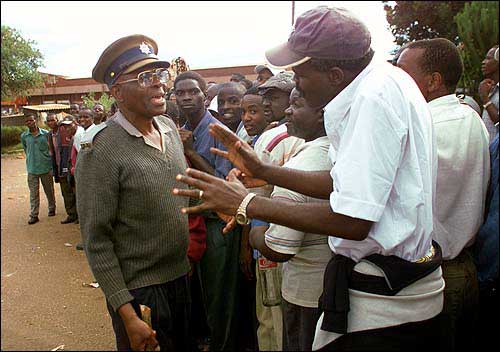
A man who has been waiting for hours to vote argues with a Zimbabwean policeman in Kuwadzana, Zimbabwe. In the hotly contested presidential campaign, Movement for Democratic Change (MDC) candidate Morgan Tsvangirai is challenging incumbent Robert Mugabe. The polls opened Saturday. Voting concludes today.
Voting was set to continue for another day today. But opposition politicians and local observers, voicing concern that time could run out before all of the country’s 5.6 million registered voters could cast their ballots, were appealing for an extension of the polls.
The race pits incumbent President Robert Mugabe and his ruling ZANU-PF party against Morgan Tsvangirai, a one-time trade unionist and the leader of the Movement for Democratic Change, or MDC. Mugabe has been president since Zimbabwe, formerly Rhodesia, attained independence from Britain in 1980.
Government critics charged Saturday that the slow pace of voting was engineered, a last-ditch attempt by the ruling party to ensure that the outcome would be in its favor.
“The intention, of course, is that you frustrate as many voters as you can,” Tsvangirai told reporters as he went on a stroll in Harare. “Mugabe is trying to move the goal posts to disenfranchise people, these people he thinks will vote against him.”
Before the election, the government reduced the number of polling places in urban areas, where the MDC dominates, and increased the number in rural areas, which traditionally have been strongholds of the ruling party.
Learnmore Jongwe, a spokesman for the MDC, said Saturday that the party had information that the government had instructed officials at urban polling places to slow down the voting process. He added that the party’s election observers had come under severe harassment and that by midmorning, voting was proceeding without MDC representatives in at least 52 percent of rural polling places.
“We find this state of affairs completely unacceptable,” Jongwe said. “A people who have waited 22 years to vote for change cannot be denied the opportunity to vote at the 11th hour.”