

401(k) savings can disappear without proper education
Workers responsible for investing in future
The 401(k) retirement plan is supposed to provide a comfortable retirement for Americans lucky enough to have one.
But with the market tanking and evidence surfacing that investors often did not benefit even when stocks were soaring, some experts wonder whether the 401(k) plan is looking more like a skimpy mattress in a fleabag hotel.
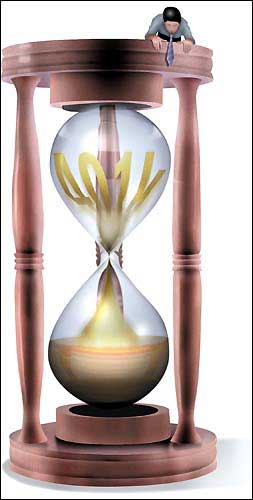
Before 401(k) plans came along, many workers had traditional pensions, known as defined-benefit plans. The companies that offered the plans had to figure out how to provide a guaranteed retirement income for employees. Defined-benefit plans were expensive for employers, however, and many began offering 401(k) plans instead.
Responsibility shift
The 401(k) moved the responsibility for saving and investing to the worker. Many workers simply don’t contribute anything to their 401(k), or not enough to retire comfortably. Others invest too conservatively or too aggressively, hurting performance. High management and administrative fees also cut into investor returns.
As a result, the 401(k) can mean that everyone wins except for the investor. The corporation has eliminated a big pension obligation, and the investment manager earns often lucrative fees.
“Everybody’s happy, except for the retiree when he finds out the cupboard is bare,” said William Bernstein, a principal at Efficient Frontier Investors in Coos Bay, Ore.
Some experts and employers are even calling for an overhaul of the retirement-savings system. Nebraska, frustrated that state workers in its 401(k)-style plan earned just 6 percent a year on average, has pushed many workers into a plan in which the state handles the investments for them.
Whether other states or private employers will follow Nebraska’s lead is not clear. In the meantime, most people still depend on 401(k) plans, and many financial experts say they are an excellent benefit for people who educate themselves about how to use them.
“The 401(k) ought to be the main retirement vehicle for the majority of people today,” said Ralph McDevitt, branch manager for the Horsham, Pa., office of Legg Mason, a Baltimore-based brokerage firm. “We don’t think anything’s changed with respect to that.”
Investment tips
Here’s some advice on avoiding an Old Mother Hubbard retirement:
Save, save, save. On average, workers contribute about 5 percent of gross pay to a 401(k). Almost all need to contribute about 10 percent if they want their income to remain the same after retirement.
“The math is a very, very hard taskmaster,” Bernstein said.
Plus, you get an immediate tax savings for every dollar contributed, said Evan Scott, president of Evan Scott Group International, a Plymouth Meeting, Pa., recruiting firm. Investors don’t pay federal income tax on 401(k) contributions.
Scott believes so strongly in 401(k) plans that he lets employees participate after one month, compared with a yearlong wait at many companies.
“It’s forced savings,” he said.
Run the numbers. Decide how much you will need to retire. Penny Robertson of Wyndmoor, Pa., used an online calculator at her mutual-fund company, T. Rowe Price, to figure she will need about $1.5 million in 401(k) and other retirement plans to live comfortably.
“I could use $2 or $3 million, but if I had $1.5 million, I could not worry,” said the 55-year-old, who works in technical support for Beckman Coulter Inc.
Choose how to invest. Once you have your number, decide how you need to invest to get there. Don’t take on more risk than you need to, advised Frank Armstrong, a Miami financial planner and author of “The Informed Investor.”
“A lot of people are already wealthy, and they’ve positioned themselves in a very risky portfolio” of aggressive growth stocks, he said.
If you can get along with a lower rate of return, putting a big chunk in short-term bonds say 40 percent or 50 percent should get you where you need to go, Armstrong said.
Compare stocks and bonds. The current stock market complicates the picture. The major market indexes are in their third year of losses. The Standard & Poor’s 500 index of stocks is down 8.1 percent this year, and the tech-heavy Nasdaq composite index is down 17.9 percent. Many investors believe stocks remain too expensive despite the bear market, meaning stocks may not offer a much greater return than bonds in the next several years.
“It’s not a settled matter, but it is an area of concern,” Armstrong said.
Bernstein said most investors should put about 40 percent of their holdings in bonds. They don’t fluctuate in value as much as stocks, so bonds will add stability to a portfolio and can minimize losses.
“You eliminate about 50 percent of the downside,” he said. Of course, your money won’t grow as quickly, but you can compensate by saving more.
Bernstein particularly abhors the advice that people in their 20s and 30s put 100 percent of their retirement money in stocks. Their longer time horizon allows them to take more risk, but their inexperience probably means they won’t tolerate losses as well as older people who have seen bear markets before. That means young people may be more prone to panic selling.
Diversify, diversify, diversify. Figure out how much to put in bonds and how much in stocks. Then make sure you have some value and growth stocks, including some international companies. You also need to invest in companies of all sizes.