

Nikon’s hot pick
New digital camera is designed for less tech savvy
New York ? My home shows how your average Gen-X techie lives. There’s a new Dell computer with high-speed cable Internet and CD burner. The entertainment system is crowned by a DVD player. I have a cell phone and a Palm handheld. Next up: a digital camera.
And yet, I am not a techie. My boyfriend selected and set up our computer. He has burned CDs; I haven’t. I rarely remember to carry my cell phone, and am ashamed to say that my Palm, which came with the computer purchased early this year, languishes unopened in its box.
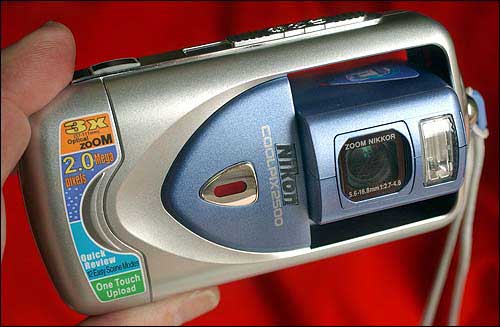
The new Nikon Coolpix 2500 is as easy to use as a simple 35mm camera, and the price is reasonable.
So I decided to try out a digital camera before buying one.
I began with the Nikon Coolpix 2500, which is being marketed to the young and trendy and offers 2-megapixel top resolution.
The Coolpix 2500 passed my first test: It is as easy to use as a simple 35mm point-and-shoot.
Setting up the camera plugging in rechargeable lithium battery and inserting flash memory card was a snap. Reviewing images on the LCD display and deleting unwanted pictures proved uncomplicated as well.
The camera also allows users to take video a whopping 15 seconds worth on the 16-megabyte memory card that ships with the camera. But I didn’t bother with this somewhat useless feature.
Along with offering all the ease of a standard point-and-shoot camera, the sleek silver-and-blue Coolpix 2500 has a unique advantage: Just rotate the camera’s inner swivel lens toward yourself and you can take your own picture. That feature came in handy on a hiking trip when my boyfriend and I didn’t want to break our fellow hikers’ stride to snap our photo.
The Coolpix 2500 also met my other criteria: size and price.
About the size of a minicassette recorder and weighing about 10 ounces with the battery, it fit easily in my purse as well as the pocket of my hiking shorts.
With a price tag of $350, chances are non-techie users like me won’t suffer as much buyer’s remorse as they might by purchasing a more expensive model, with features they might never bother to learn or don’t need.
Still, I had some minor issues with the Coolpix 2500.
There is a long time lag between snapping and processing photos. And it was difficult to compose pictures in darker settings because the camera’s LCD display also serves as the viewfinder. Of course, I might have gotten around that by using the camera’s manual features, or its night setting option.
Transferring pictures directly to the computer via USB connection, without having to remove the flash memory card, was easy. The Nikon View 5 image management software, which is included, worked fine but the prompts for how to e-mail photos weren’t exactly intuitive.
Overall, however, this camera has about what I need and little more.
While its top resolution of 2 million pixels is less than half the quality of cameras geared toward professionals and demanding hobbyists, it’s plenty sufficient for producing crisp snapshots, which is exactly what I’m after.
It doesn’t matter to me that I wouldn’t be able to blow up pictures larger than 8 inches by 10 inches, and that even at that size the resolution might suffer.
The Coolpix 2500 makes up for that, though, with a 3X optical lens, comparable to 37mm-111mm, and a 4x digital zoom.
The rechargeable lithium battery gives you about 60 minutes operating time. While the 16MB memory card only stores 16 photos at top resolution, the camera will, of course, accommodate cards with much more room.
I’d consider purchasing the Coolpix 2500, after trying out another digital camera or two. This camera does offer a personal selling point: My boyfriend was impressed to come home to find I’d transferred photos to our computer without his help.
I haven’t told him how easy it was.