

Differences delay Afghan council
Kabul, Afghanistan ? Arguments among delegates to Afghanistan’s grand council on Sunday delayed by at least a day efforts to choose members of a national assembly.
President-elect Hamid Karzai proposed creation of an assembly to the council, or loya jirga, on Saturday. Karzai asked that members of the council establish a commission for him to consult when he takes office of a transitional government later this month.
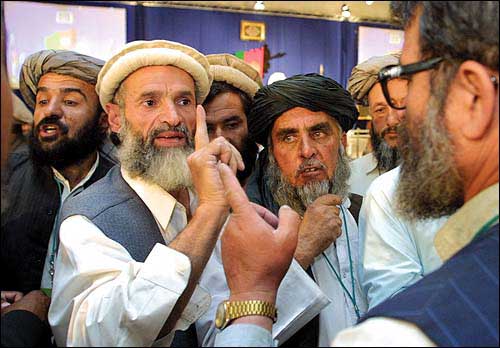
Unidentified delegates to Afghanistan's loya jirga, or grand council, argue about the formation of a new legislative body after confused delegates rushed the stage. The grand council in Kabul adjourned for a half-hour to allow delegates to calm down.
On Sunday, when the council was to conclude, two proposals before the more than 1,500 delegates stalled. One calls for two representatives from each of Afghanistan’s 32 provinces with a small number of seats set aside for women, nomads and refugees. The other calls for the election of one representative from each province for every 10 delegates representing that province at the loya jirga.
Tempers were hot, and at one point a crowd of delegates swarmed the desk of the chairman and loudly argued their views. A 30-minute recess calmed them down, and the meeting remained orderly thereafter.
“The delegates have a proposal for the nomination of two representatives from each province,” said Abdul Wahab Pilot, a delegate representing Afghan refugees from Pakistan. “But not all provinces have an equal number of population.”
Delegates from sparsely populated Pashtun provinces such as Kandahar and Paktia pushed for the first proposal. Those from densely populated areas of the north, where the northern alliance draws its strength, favored representation proportional to population.
Pashtuns reportedly would have walked out of the loya jirga if a vote had been taken on Sunday and the 10 percent proposal had carried the day.
Women delegates also want their numbers considered.
“We are 60 percent of the population,” said Sohaila Hashmi, 22, a delegate from Bamiyan. “During Taliban time we did not have rights. Now the Taliban is gone. We should have our share of politics. Give us our rights.”
Delegates also need to decide the makeup of a Cabinet, but many now expect Karzai to make those decisions.
In the current Cabinet, Tajiks and Uzbeks associated with the northern alliance fill the most powerful positions. That’s a sore point with the Pashtuns. Afghanistan’s Uzbeks and Hazaras also feel underrepresented.
“If Karzai picks his own (Cabinet), the northern alliance will choose and then what will have changed?” said Omar Zahkilwal, 48, a Pashtun delegate who left Afghanistan in 1977 and now teaches in Canada.
Extension of the weeklong loya jirga did not disturb Farzana Husaini, 37, a delegate from Herat.
“This process has been very democratic,” Husaini said. “There are some people complaining that they have not been given the right to talk. But with 1,500 people it is very difficult for everyone to have their say.”