

Black coaches weary of waiting for chance
Raleigh, N.C. ? There are few coaches in the Atlantic Coast Conference like Paul Hewitt.
Five, to be exact.
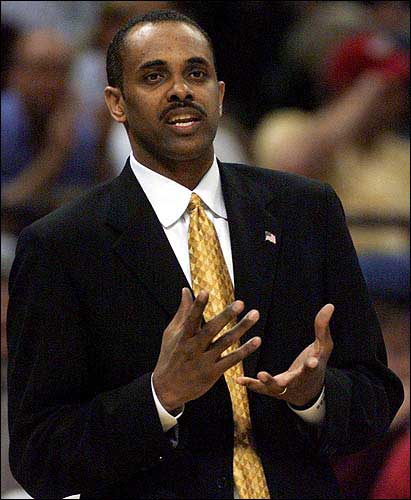
Georgia Tech basketball coach Paul Hewitt instructs his team. The Atlantic Coast Conference had just six black head coaches in all sports last year.
The ACC will celebrate its 50th anniversary next season, but the league is still almost devoid of color on the sidelines.
An NCAA study says other leagues are dealing with substantial disparities between the percentage of black coaches and black student-athletes. And progress is being made at a pace befitting a Florida recount.
“It’s not happening fast enough,” said Hewitt, the Georgia Tech men’s basketball coach. “(Qualified coaches) are there let’s not kid ourselves. What we have to get to is why people are afraid to pull the trigger.”
The ACC has six black head coaches: Hewitt, Clemson women’s track coach Marcia Noad, Florida State men’s basketball coach Leonard Hamilton, Georgia Tech women’s tennis coach Bryan Shelton, Maryland men’s and women’s track coach Bill Goodman, and Wake Forest women’s basketball coach Charlene Curtis.
In 1999, there were only four: Goodman, Curtis, Florida State men’s basketball coach Steve Robinson and Wake Forest football coach Jim Caldwell. Robinson and Caldwell have since been fired after struggling to build winning programs.
The responsibility for changing those numbers lies with the schools, ACC commissioner John Swofford said.
“It’s something that league-wise is important, and yet the league doesn’t hire the coaches,” he said. “I think institutions are interested in hiring the very best individual they can hire.
“What has to be kept in mind is the basis of equal opportunity. I think you do have to make an effort to search for minority candidates anytime you make a hire. I think our schools do that.”
Still, the league boasts 197 varsity programs, meaning that blacks constitute just 3.6 percent of the ACC’s head coaching ranks, according to data collected from the individual schools by The Associated Press.
That percentage is less than the national average, according to a biennial study by the NCAA Minority Opportunities and Interest Committee.
The latest study, released in 2000, shows that blacks made up 5.8 percent of head coaches and 15.1 percent of assistant coaches at non-historically black Division-I schools in 1999-2000. Blacks made up 18.9 percent of all student-athletes that year.
The coaching percentages were up from 5.1 percent and 14.3 percent, respectively, in 1995-96, the first year of the study.
The disparity is even greater for the major sports: football, men’s basketball and women’s basketball.
Blacks made up 45.3 percent of student-athletes in those revenue sports, but just 13.7 percent of head coaches for men’s teams and 7.3 percent for women’s, according to the study.
The next study is expected to be released in August.
Committee chairman Eugene Marshall, Jr., the women’s basketball coach and athletics director at Ramapo College in Mahwah, N.J., said the ACC is slowly making progress.
Marshall, also a member of the board of directors for the Black Coaches Association, points to the fact that Virginia hired Craig Littlepage as its first black athletics director last August, and that Hamilton and Hewitt have taken over programs in a high-profile conference known for excellence on the hardwood.
“I just think that like everybody else, (the ACC) has to understand that it’s time to change,” Marshall said. “They have to look at hiring the most qualified candidate and be courageous enough to hire people of color.”
Beneath the numbers and percentages lurks the question: Why are there still so few black head coaches?
“Unfortunately, I think these issues are just a reflection of what’s gone on for many years in our society,” Hamilton said. “These things are slow to change like they always have been, and it takes open-minded people who put forth an effort to make these types of social changes.”
Swofford, who served as athletics director at North Carolina for 17 years before becoming ACC commissioner, said administrators often look for coaches who have proven themselves at equal or higher levels of competition.
Marshall said that can limit the opportunities given to successful coaches at smaller or historically black schools.
Either way, it often leads to the same names being recycled as job openings emerge.
“I think in some cases the decision may come down not only to comfort, but what may be the easiest thing to do, the easiest thing to justify or sell,” Littlepage said.
A breakout season by a black head coach in any program nationwide could trigger more administrators to follow suit. Hewitt, who has been at Georgia Tech for two years, credits former Georgetown men’s basketball coach John Thompson for opening doors for black coaches by leading the Hoyas to the 1984 NCAA championship.
He’s hoping the same thing happens for football coaches with this year’s hiring of Tyrone Willingham as the first black football coach at Notre Dame. Willingham is one of four black head football coaches nationwide in Division I-A, a figure Hewitt called “insulting.”
“Copycatting is a big thing in the sport,” he said. “If Tyrone Willingham wins a national championship at Notre Dame, you can bet it will be the en vogue thing to hire black coaches. I think people want to win, but they’re also afraid to break from the norm until they see it work.”
Swofford, Littlepage and Dick Baddour Swofford’s successor at North Carolina each said league and school administrators are concerned by the numbers. They also said they don’t sense any hesitation among their fellow administrators to hire a black head coach.
North Carolina, the ACC’s leader with 28 varsity sports programs, has had only one black head coach: Hubert West, who coached men’s and women’s track in Chapel Hill from 1982-83.
“It does bother me,” Baddour says, “and I want to be a part in changing it.”
Baddour said black candidates were considered when the school’s men’s basketball and football coaching positions were vacant in 2000. In both cases, the school hired white alumni Matt Doherty and John Bunting.
Curtis puts some burden on the head coaches and assistant coaches. She said assistant coaches must master running all areas of a program, avoiding being “pigeonholed” into a task such as recruiting. She said the head coaches in turn must mentor those assistants and other young coaches.
Shelton, who was named ACC women’s tennis coach of the year in April, takes the responsibility even more personally.
“It’s important for the coaches to do a good job so they’re not just taking care of their teams and families,” he says. “Hopefully they’re creating more opportunities for people in the future.”
Until then, black coaches will have to wait for progress to catch up to the speed of the game.
“It saddens me,” Curtis said, “but I’ve been in the business long enough to know our time is coming. The more black coaches are successful, the wider the door will be.”