

Teenagers often are unaware of hazards in the workplace
Washington ? For millions of teens, summer is about more than making tracks to the beach. It’s when they flood the job market, exposing themselves to the rewards of the workplace – and its dangers.
The first thing on their mind is money. The last thing may be safety.
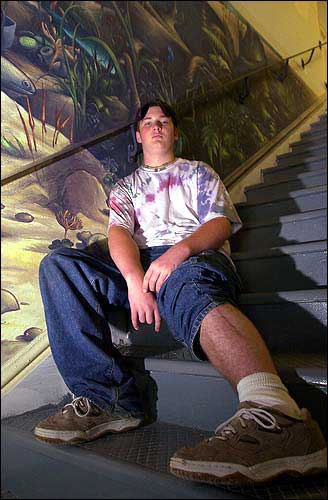
Andrew Britton sits by a mural he helped paint in the Ely Chapman Education Center in Marietta, Ohio. Britton spent three days in the hospital last summer after he slipped off a trash trailer on his second day at work. Many young people are too focused on getting paid to grasp that they could be hurt or killed.
More than 500 teen-agers are injured at work every day on average. About one is killed every five days. And some companies are not doing enough to tell teens how to stay safe or to keep them out of harm’s way.
Brad Hurtig, a 17-year-old football star, was a few hours into his first shift at an Ohio metal stamping company last month when he got his hands caught in a power press. Both had to be amputated.
Adam Carey had worked at a country club north of Boston for barely a month when the golf cart he was driving slammed into a wooden deck, crushing his chest.
At 16, too young to be driving even a golf cart under Massachusetts law, Carey was one of 73 teens killed on the job in 2000.
His mother, Maggie, wishes she’d paid more attention to the fact that he was driving.
“We assumed that that was an acceptable thing for him to do,” she said. “Being a kid, he certainly didn’t sit down and read the laws.”
And if the club told him to drive, she said he would have done it regardless. Now she urges friends to know what their children do at work, to know the law and not to assume the employer is looking out for their children.
The Labor Department says about 4 million 15- to 17-year-olds earn paychecks during summer vacation. Eight in 10 teens will work at some point during high school.
Dangerous areas
The National Consumers League advocacy group says the most dangerous jobs for young people are:
- Driving and delivery, including operating or repairing motorized equipment.
- Working alone, and late at night, in businesses where money is exchanged.
- Cooking, with exposure to hot oil and grease, hot water and steam, and hot cooking surfaces.
- Construction and working at heights.
- Traveling youth crews: groups of children recruited to sell candy, magazine subscriptions and other items in neighborhoods and on street corners.
At a fast-food restaurant near Youngstown, Ohio, a teen was burned after the boss insisted he dump the contents of a deep fryer into a plastic bucket, a state official said. The bucket melted, releasing hot grease that melted the boy’s shoes and caused him to fall into it.
Judy Elliott, who runs the New Hampshire Coalition for Occupational Safety and Health, said many teens are too inexperienced or poorly trained to recognize dangers in places like restaurant kitchens where doing multiple tasks is common.
“It’s hard to be safe when you’re running in five directions,” said Elliott, whose program tries to educate high school students about job safety.
Andrew Britton of Marietta, Ohio, was hospitalized for three days last summer after his leg was slashed on his second day of work at a recycler, causing nerve damage and requiring 30 stitches.
He was 14 then, and said he only remembers getting a general warning to be careful. But Britton said what happened was an accident and no one’s to blame.
He’s painting murals this summer.
Federal and state laws on child workplace safety can be confusing. And what teen-ager even thinks about reading them?
Before starting as a supermarket cashier, Jeff Williams, 16, of Gibbstown, N.J., said he was trained how to handle spills, falls and broken items.
Asked what he knew about the labor laws, Williams said, “We have signs posted all over the place, but I don’t think anyone reads them.”
Jelinus Watson, 16, of Atlanta, worked with his father in construction last summer – although he was a year too young under federal law to be employed in what was the deadliest industry of 2000.
“Half the time I was scared out of my mind,” said Watson, who is working at an amusement park this summer. “A hard hat doesn’t cut it. I would much rather work as a ride operator.”
Investigating cases
At the time of his accident on June 10, Hurtig apparently was unsupervised and using equipment not meant to be operated by a minor, said Robert Glenn, spokesman for Ohio’s Bureau of Workers’ Compensation.
Tami Lupton, speaking for the boy’s employer, A-Stamp Industries of Bryan, Ohio, said Hurtig was supervised but she declined to discuss the accident further.
The federal Occupational Safety and Health Administration is investigating.
In Massachusetts, Carey’s driving apparently didn’t violate federal law, which bans workers under 17 from driving on public roads. The Kernwood Country Club in Salem is private.
But it was illegal under state law. No criminal charges were filed in the case, and the state attorney general’s office declined to comment. The federal occupational safety agency fined the country club $1,000 for not reporting Carey’s death within eight hours.