

IRA apologizes for deaths in 30 years of bombings
Dublin, Ireland ? The Irish Republican Army issued an unprecedented apology Tuesday for hundreds of civilian deaths during 30 years of bombings and other attacks, a surprise gesture that could ease a crisis threatening the survival of Northern Ireland’s government.
Prime Minister Tony Blair’s government quickly welcomed the IRA statement, noting the strength of the apology, which comes at a time when the peace process forged in 1998 is under severe strain from continuing sectarian violence.
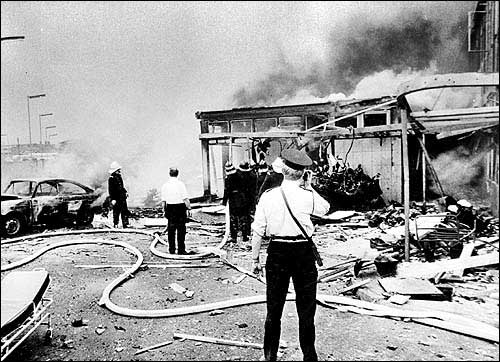
Rescue workers respond to the scene of an explosion in the heart of Belfast, Northern Ireland, on Friday July 21, 1972, a day that later became known as Bloody Friday, when the IRA set off more than 20 bombs within an hour in Belfast. The Irish Republican Army on Tuesday issued an unprecedented apology for the hundreds of non-combatant civilian deaths in the last 30 years.
The apology marks the anniversary of Bloody Friday, when the IRA set off more than 20 bombs within an hour in Belfast on July 21, 1972, killing seven civilians and two soldiers and wounding scores.
“While it was not our intention to injure or kill noncombatants, the reality is that on this and on a number of other occasions, that was the consequence of our actions,” the statement said. “We offer our sincere apologies and condolences to their families.”
Although the IRA has stated its regret in the past for individual acts, it has not previously issued so sweeping an apology, nor was it required by the 1998 peace accord.
The statement released through An Phoblacht-Republican News, the weekly IRA-Sinn Fein newspaper in Dublin, said the apology was aimed at improving the atmosphere in the territory’s peace process.
But David Trimble, leader of Northern Ireland’s biggest Protestant party, the Ulster Unionists, and head of the Catholic-Protestant government, had reservations.
“It is quite significant that this statement says nothing at all about the recent violence that the IRA has been involved in, nothing about what their future conduct is going to be,” Trimble said in the House of Commons.
“Consequently this statement does not absolve the prime minister from the need for him to make clear what the government will do in the event of breaches,” of the cease-fire by the IRA.
Trimble has warned the power-sharing arrangement would unravel if Blair doesn’t set a tougher policy on alleged violations of the IRA cease-fire.
The outlawed organization also acknowledged the grief and pain of the families of the combatants police, soldiers and paramilitaries killed during the violence.
Its statement said the future would not be found in “denying collective failures and mistakes, or closing minds and hearts to the plight of those who had been hurt. That includes all of the victims of the conflict, combatants and noncombatants.”
“On this anniversary, we are endeavoring to fulfill this responsibility to those we have hurt,” it said.
More than 3,600 people have been killed during the 32-year conflict over Northern Ireland’s future. The IRA has killed about 1,800, about 650 of them civilians and the rest mainly police and soldiers. Protestant extremists have killed 1,050, mostly Catholic civilians. British forces have killed about 350 people.
Responsibility for about 100 deaths has never been confirmed.
The IRA gesture was designed to assuage Protestant anger over the continued involvement of the IRA linked-Sinn Fein party in Northern Ireland’s joint Protestant-Catholic government.
Protestant political parties accuse the IRA of repeatedly violating its 1997 cease-fire, and Blair is expected to make a statement in the next week about the status of that cease-fire and the survival of the peace process.