

Analysts warn market putting rebound at risk
Washington ? The stock market is rapidly turning into the biggest wild card in the economy, raising fears that the recent stomach-churning drops in stock prices could derail the fledgling recovery.
The Bush administration is insisting the problems on Wall Street won’t disrupt the upturn on Main Street, but private economists are nervous.
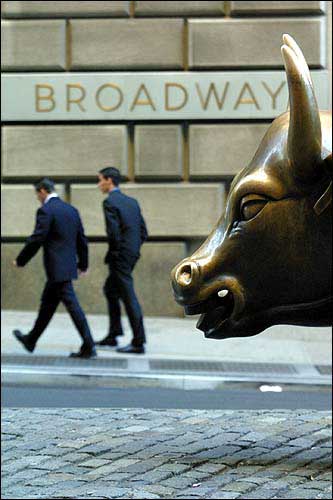
Two businessmen walk behind the bull on Broadway in New York's financial district. Investors unloaded stocks again Thursday as an investigation of Bristol-Myers' books and another downgrade of General Motors further sapped the market's confidence.
“My level of angst is rising with every day that passes and every new 100-point decline in the Dow,” said Mark Zandi, chief economist at Economy.com. “The risks to the economy are awfully high.”
The market’s newest troubles come after a wave of accounting scandals has heightened investors’ concerns about the state of U.S. corporations, which have seen their profits battered by the recession that began in March 2001.
Stocks were mixed Thursday, with the Dow Jones industrial average dipping by 11.97 points to close at 8,801.53. The decline was much smaller than the triple-digit losses during the first three trading days this week, which saw the Dow shed 566 points to close below the 9,000 level for the first time since the days following Sept. 11.
So far this year, the broader Standard & Poor’s 500 stock index is down by nearly 20 percent.
Many economists are saying the recovery probably began in January. Stocks, though, have suffered a double-digit decline in the first six months of this upturn, something that has never happened before. Normally, stocks enjoy double-digit increases in the early months of a recovery.
Analysts say the big question now is whether stocks, which can be a barometer of the future course of the economy, are signaling trouble for the recovery.
“The market decline certainly increases the odds of dipping back into recession because it makes things more fragile,” said David Wyss, chief economist at Standard & Poor’s in New York.
The worry is that falling stock prices will trigger a “reverse wealth” effect. The stock market’s boom of the late 1990s propelled Americans to spend more as they saw their investment portfolios rising. The personal savings rate dipped to record lows in those heady days.
But the process can work in reverse, with a falling stock market engendering a cutback in spending as worried consumers watch their portfolios shrink.
Since consumer spending accounts for two-thirds of the total economy, troubles in this area can translate into big problems overall.
So far, such a development remains only a worry. The nation’s big retailers reported Thursday that they had experienced strong sales in June. Home sales and auto sales have been robust this year, helped by the lowest interest rates in decades.