

Arafat showing strain of challenge to authority
Jerusalem ? It was a startling scene even for the mercurial Yasser Arafat: during an argument, the Palestinian leader tried to punch his West Bank security chief and pulled a gun on him for defying orders.
Arafat’s outburst may have been more than political theater, with some saying he appears increasingly unnerved by open talk in Israel and more discreet whispers in Washington about sidelining him.
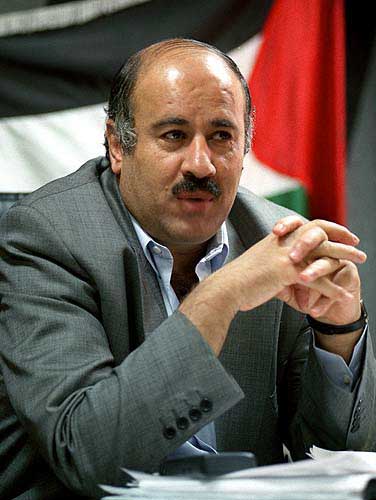
Jibril Rajoub is head of the Preventive Security service in the West Bank. During an argument Monday, Palestinian leader Yasser Arafat tried to punch Jibril Rajoub and pulled a gun on him for defying orders.
The target of Arafat’s wrath was Jibril Rajoub, head of the Preventive Security Service in the West Bank and a man tagged by Israeli leaders as one of the younger, more pragmatic Palestinians they feel they could do business with.
Arafat summoned Rajoub to his compound in the West Bank town of Ramallah on Monday, angered by the escape of prisoners from a lockup under Rajoub’s control and the security chief’s refusal to help dismantle the Al Aqsa Brigades, a militia linked to Arafat’s Fatah movement.
Arafat yelled at Rajoub and at one point jumped from his chair, trying to punch his security chief in the face, said Palestinian officials familiar with the incident. The barrel-chested Rajoub caught Arafat’s hand in mid-air, said the officials, speaking on condition of anonymity.
At that point, Arafat pulled a pistol from a hip-holster, the officials said. One aide shouted at Arafat, “Don’t do it,” while others wrested the pistol from Arafat’s hand, letting it drop to the floor. Rajoub got up and left.
Some Palestinians played down the episode as vintage Arafat: many times in the past, the Palestinian leader has yelled at his lieutenants, cursed them or banished them from the inner circle, only to make amends with hugs and kisses.
Palestinian legislator Hanan Ashrawi said she spoke to Arafat after the incident with Rajoub, and that he told her he had to assert his authority.
“According to Arafat, it’s a matter of discipline,” Ashrawi said. “It’s a matter of knowing that one person takes the decisions, and he (Arafat) feels this is a situation of crisis, and he feels it is important that everyone comply.”
Arafat’s aides remained silent, and the Palestinian media didn’t report the confrontation; Palestinians learned of it from Israeli newspapers and TV reports.
Rajoub published a pledge of loyalty to Arafat in the Palestinian daily Al Quds on Wednesday and said anyone challenging the Palestinian leader while he is under Israeli siege was committing treason.
Yet in an interview with Israel TV’s Channel 10, he was more ominous. While again professing his loyalty, he said: “The time will come when I will say what happened … Nobody can do anything to me.”
Abdel Jawad Saleh, an outspoken Arafat critic and former Palestinian agriculture minister, said he believed Arafat was feeling increasingly pressured. “Maybe he is feeling that the Americans and the Israelis want to replace him, and he wants to show them that he is boss,” Saleh said.
Another dissident, political science professor Abdel Sattar Qassem, said Arafat appeared to be worried about talk of a new leadership, and that “Rajoub is one of the names that has been looming.”