

Don’t let holidays chase you into debt
Experts advise consumers to begin with budget
Walnut Creek, Calif. ? Last Christmas, Susan O’Neill wanted to wow family and friends with great gifts.
So she spent $300 on a Banana Republic coat for her husband and even gave gifts to the letter carrier and baby-sitter.
But the more than $1,200 she spent on presents left her with a headache in January. About $700 of it went on a credit card that she couldn’t pay off for a month. When her husband found out how much the jacket cost, he stopped speaking to her for a time, O’Neill said.
“It kind of made me realize that there’s more to the holidays than this crazy spending,” said O’Neill, a 35-year-old Pleasanton, Calif., woman.
The generous spirit of the holiday season can tempt shoppers to spend more than they can afford, leaving them with financial hangovers that take months to wear off. Spending experts say the holidays are one of the most dangerous times for consumers to rack up credit card debt, sometimes nudging well-intentioned givers into financial turmoil.
Consumer Credit Counseling Service of East Bay, Calif., gets about 400 more calls in February ” when holiday bills arrive ” than a typical month, said Shirley Dean, the organization’s community relations and education director. They cause enough financial problems that the group offers a class called “Surviving the Holidays.”
What happens is shoppers use credit cards to buy presents either because it is convenient or because they don’t have the cash in their bank accounts to pay for gifts. More than half of shoppers plan to use a credit card for holiday purchases this year, according to a survey by the Consumer Federation of America and the Credit Union National Assn.
About 40 percent of card users pay their balances in full when the bill comes, according to CardWeb.com, a Maryland firm that tracks the payment card industry. But the 60 percent who don’t pay in full get socked with interest rates often in the double digits that gradually fatten credit card bills. Of those surveyed by CFA and CUNA, 27 percent said they worry about paying off holiday debt.
Last year, consumers charged about $75 billion on holiday-related purchases between Thanksgiving and Christmas, according to CardWeb.com. For the people who don’t pay their cards off immediately, it typically takes between four and six months to pay them in full, said Robert McKinley, CardWeb.com’s chief executive officer.
CardWeb.com expects consumer credit card debt levels will increase between 7 percent and 8 percent this year. That’s down from a 16 percent increase last year as consumers roll card debt into their mortgages to cash in on low rates. Consumers are carrying an average of about 11 weeks worth of their take-home pay in nonmortgage debt, said Bill Hampel, chief economist for the Credit Union National Assn.
So why do we spend more than we can afford at Christmas? Financial experts say that the holidays make people spend from their hearts instead of their heads.
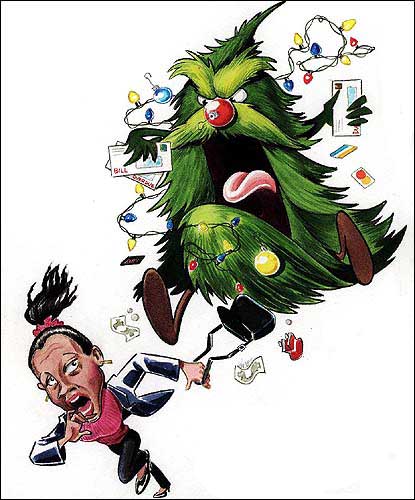
“The holidays are very emotional,” said Dean of the credit counseling organization. “We’re trying to recreate that memory of happiness and joy that we had when we were kids. Lots of times we equate that with money and gifts.”
It’s easy to set out with the intent to simply spend less money this year. But experts say it is more effective if you carefully plan and structure your spending.
The following is a list of tips compiled from local and national financial experts on how to avoid going into debt during the holidays.
- Before you start shopping, decide exactly how much you can afford to spend. This may sound obvious, but many shoppers define their shopping by what they want regardless of whether they can pay for it.
Dean suggests starting with two dollar figures. One is the cost of everything you want to buy. The other is how much money you actually have to spend on those things. If the wants figure is bigger, cut out gifts until the number matches the money you have.
Don’t limit your budget to gifts. Include cards, wrapping paper, stamps, decorations, food, entertainment, travel, clothing and anything that costs money during the holidays.
- Start an account for holiday spending. Some banks and credit unions offer Christmas Club accounts that regularly withdraw money from a savings account and put it in a different holiday-designated stash. Bank of America’s holiday account pulls out $20 per month or more and pays users their balances on the first business day in November.
- Determine what makes the holidays fulfilling. Dean has students close their eyes and visualize themselves being happy during the holidays.
“Almost every time that you do that, you find that the things that are so wonderful and important are not the things that cost money,” Dean said.
- If you have the time, make gifts and decorations by hand instead of buying them.
- Spread your gift buying throughout the year. That way holiday bills don’t pile up all at once.
- Make paying off your credit card purchases immediately a priority. If you just keep making the minimum payment, you probably will never pay the card off, according to CUNA and CFA. To ensure you pay it off, use an American Express card that requires paying the balance in full.
- Don’t have too many credit cards in your wallet. Michael Tilles, a certified financial planner with American Express Financial Advisers in Walnut Creek, Calif., said most consumers only need one or two credit cards. If you’re tempted by available credit, he suggests putting the cards in a jar of water and keeping them in the freezer.
Determined not to overspend this holiday season, O’Neill of Pleasanton, Calif., gave herself a $1,000 budget and plans to say no to gifts that stretch her designated limit.
Even though her family is making more money this year, she’ll only spend $100 on her husband and buy discount gifts for her daughter.