

U.S. contemplates response to Iraq statement on weapons
Washington ? Iraq signaled Tuesday that it would soon declare it is free of weapons of mass destruction, setting the stage for a renewed confrontation with the Bush administration.
A senior U.S. official said that President Bush will launch an aggressive effort to demonstrate that the expected Iraqi claim is false, using U.S. intelligence data and pressing the United Nations to conduct weapons inspections with that goal in mind. The official spoke on condition of anonymity.
Bush’s top national security advisers met Tuesday at the White House to discuss U.S. responses to Iraq’s expected claim. They plan to reconvene on Thursday, after Secretary of State Colin Powell returns from a two-day trip to Colombia.
Under a resolution adopted unanimously by the U.N. Security Council last month, Iraq has until Sunday to make a full confession of its programs to develop nuclear, chemical and biological weapons and the missiles to deliver them.
A senior Iraqi official suggested that the document, which he said will be delivered Saturday, will declare that Saddam Hussein’s government no longer possesses such weapons.
“We are a country devoid of weapons of mass destruction,” said Hussam Mohammed Amin, head of the Iraqi National Monitoring Directorate.
The United States has promised Britain, its closest ally, that it would not launch a war against Iraq solely on the basis of a weapons declaration that it deemed false, said a senior Bush administration official, speaking on condition of anonymity.
Rather, the senior official said, Bush and his aides are expected to launch a full-scale effort to prove the Iraqi document is false. That effort could take until next month, meaning the president could face a decision in January on whether to go to war.
First, the United States will carefully scrutinize the Iraqi document and compare it with U.S. intelligence information, a process that could take days or more.
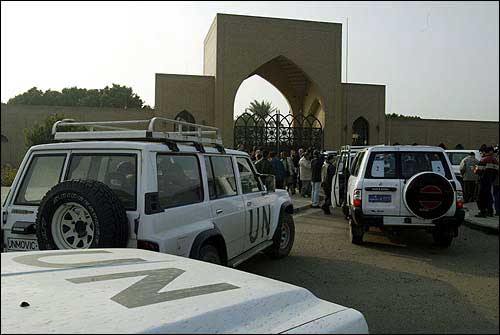
United Nations weapons inspectors wait for clearance to enter Al-Sajoud palace, one of Saddam Hussein's presidential palaces along the Tigris River in Baghdad, Iraq. Inspectors spent about two hours Tuesday at the palace and did not disclose any details of their search.
Then the United States will press chief U.N. weapons inspector Hans Blix to “really do an audit, in effect, of the final declaration,” said the official, who spoke on condition of anonymity. “The end result of that . . . is to show the declaration to be false.”
As part of the effort, Washington is expected to share additional intelligence data with Blix, other officials said.
Defense Secretary Donald Rumsfeld said Tuesday that, in the event of a false Iraqi declaration, the United States could begin ratcheting up pressure on Saddam by accelerating a buildup of U.S. ground forces in the Persian Gulf region for a possible invasion.
Top U.S. officials predict that Saddam will never admit the full scale of his weapons of mass destruction programs.
They base the prediction both on the importance of those weapons to Saddam’s rule as well as past history.