

Discover the trail of Lewis and Clark
Bicentennial events expected to draw millions along explorers' route
Sioux City, Iowa ? On a bluff overlooking the Missouri River, a sandstone obelisk stands as a tribute to the lone explorer who died on the Lewis and Clark expedition to the Pacific Ocean nearly 200 years ago.
Local history buff Bev Hinds says the monument marks the success of the 1803-06 journey even as it serves as a memorial to Sgt. Charles Floyd, who is believed to have died of appendicitis.
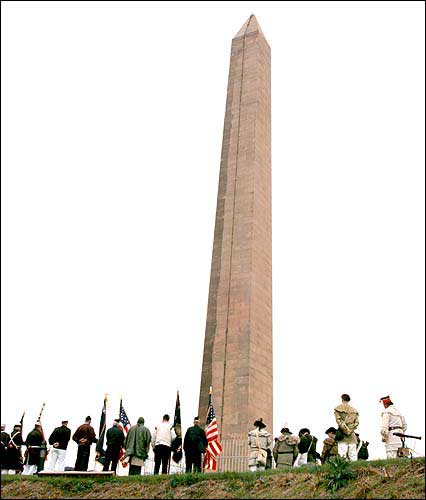
Re-enactors bow their heads during a rededication ceremony for the Sgt. Charles Floyd Monument in Sioux City, Iowa, in this May 30, 2001, file photo. Sgt. Floyd was the only member of the Lewis and Clark Expedition to have died while on the journey; the monument marks his gravesite.
“The fact that they survived all the accidents that happened to them” was incredible, Hinds says. “You couldn’t do it today.”
But states along the route are hoping the upcoming bicentennial of the Corps of Discovery will lure tourists and their dollars to trek the trail.
Between 20 million and 30 million people are expected to retrace at least some part of the trail between 2003 and 2007, says Mark Monson, chairman of the Iowa Lewis and Clark Bicentennial Commission.
“I think the reason that people are going to travel the trail is because it’s about America,” he says.
“It’s kind of like the genealogy of the United States. It’s why we are today … I think it’s good for people to understand how we got where we are.”
Modern-day explorers
On a recent summer afternoon, the Stauffer family of Roswell, Ga., stopped at Lewis and Clark State Park in Onawa, about 30 miles south of Sioux City.
It was the first stop in their three-week trip along the trail.
“We’re just always amazed by the big sky of the West,” says Kirk Stauffer, 44. “The discovery of the West, that sense of discovery, is what inspires me.”

Bill “Buffalo Bill” Sanders, a park volunteer clad in an elkskin coat and buffalo cap, estimates that nearly half of the park’s visitors come because the explorers camped there in early August 1804.
In nearby Sioux City, organizers are planning a pageant and a play to commemorate the trip. They’ll also stage a series of public lectures this fall about the area’s people, plants and animals 200 years ago.
An interpretative center, which will feature murals of the expedition and hands-on exhibits, is set to open in September.
“I think it’s a chance for us to capitalize on economic opportunity, increased sales, increased occupancy,” says Skip Meisner, one of the organizers. “I see it as a way to manufacture and have new product and to have new business start-ups.”
Clash of cultures
On the Fourth of July, President Bush declared 2003 to 2006 the Lewis and Clark Bicentennial.
| Stops on the trail
2003Charlottesville, Va. The Thomas Jefferson Foundation will inaugurate the national commemoration of the Lewis and Clark Expedition bicentennial with a party on the grounds of Jefferson’s home. Jan. 18, 2003Sioux City, Iowa Opening of a new interpretive center along the Missouri River providing exhibits about the Corps of Discovery and its stay in the area. September.Louisville, Ky. and Clarksville, Ind. A three-day send-off party with exhibits and activities at the site where Lewis joined Clark and the expedition party set out for the Missouri River. Oct. 24-26, 2003.2004St. Louis National Louisiana Purchase Bicentennial Committee will observe the 200th anniversary of the transfer of Louisiana Territory from Spain and France to the United States. March 14.Hartford, Ill. To commemorate the Corps of Discovery’s departure from its winter encampment at Camp River DuBois on May 14, 1804, Hartford and Wood River will stage ceremonies and re-enactments. Spring.St. Charles, Mo. Marking of the arrival of the expedition’s keelboat in St. Charles from Camp River DuBois. A week full of crafts, parades and a musical about Lewis and Clark’s time in St. Charles. Spring.Atchison and Fort Leavenworth, Kan., and Kansas City, Mo. These Missouri River communities will salute the first Independence Day celebrated in the American West. July 3-4.Omaha, Neb. Commemoration of the expedition’s first meeting with American Indians near Omaha. The Omaha Tribe stages the 200th anniversary of its Annual Harvest Dance Powwow. Aug. 3-4.Sioux City, Iowa Pageant and play commemorating the Lewis and Clark expedition’s stay in the area. August.Oacoma, S.D. A circle of teepees representing nine tribes in South Dakota will celebrate their history, culture and land. Aug. 27-28.Bismarck, N.D. Regional commemoration of the meeting between the expedition and the Mandan, Hidatsa and Arikara tribes during the winter of 1804-05. Oct. 22-31.2005Great Falls and Fort Benton, Mont. Will mark the expedition’s portage around the Great Falls area of the Missouri. July 3-4.Lower Columbia region in Oregon and Washington To celebrate the expedition’s arrival to the Pacific Ocean, the Lower Columbia region will play host to a national observance of the expedition’s stay in Fort Clatsup. Fall.2006Pompey’s Pillar and Billings, Mont. Anniversary of Clark’s inscription of his name on Pompey’s Pillar, a sandstone pillar on the edge of the Yellowstone River that he named after Sacagawea’s son. July 25. |
“The Lewis and Clark Expedition will stand forever as a monument to the American spirit, a spirit of optimism and courage and persistence in the face of adversity,” Bush said.
Critics, including many American Indians, said the expedition was a prelude to an invasion of the American West that wiped out countless Indians and nearly destroyed their culture.
The president also signed an executive order meant to preserve that culture, support education and improve Indians’ economic plight at tribal colleges.
In 1803, President Jefferson sent Meriwether Lewis and William Clark and a corps of 33 men on a 4,000-mile journey to the Pacific Ocean.
When Lewis and Clark journeyed up the then-curvy Missouri, they labored against a strong downstream current Sanders said they walked maybe two miles for every one they advanced and slogged through waves of mosquitoes. They also battled dysentery, struggled to find food and their way along parts of the route.
The explorers also were aided by American Indians, such as Sacagawea, a Shoshone woman who made the trip with her infant son and helped the expedition secure horses at a critical time.
“Lewis and Clark were successful because of the assistance they received from Native American tribes,” Monson says.
That’s why the bicentennial is seen as a commemoration, rather than a celebration: “It did change (the Indians’) culture, I would suspect, for the worse,” he says.
Daphne Richards-Cook, a member of the Ogalala Sioux, is organizing a circle of teepees at Oacama, S.D., to represent nine tribes in the state.
“We want to clear up the misconceptions and stereotypical views they have about our Sioux tribes in South Dakota,” says Richards-Cook, chairwoman for a tribal tourism group.
‘Marvelous undertaking’
Organizers in seven Midwest states have met twice to discuss Lewis and Clark events and to coordinate activities.
Other Midwest events include Illinois’ celebration of the expedition’s departure from Camp River DuBois; Missouri River communities in Kansas will salute the first Independence Day in the American West; and in Nebraska, organizers will celebrate the expedition’s first meeting with American Indians living in the West.
Lewis and Clark returned from their trip laden with journals describing the people, plants, animals and landscape they encountered.
In one respect, they returned empty-handed: They discovered that the Northwest Passage to the Pacific a long-dreamed of waterway through the United States that would link Europe to Asia didn’t exist.
Experts say it took years before people understood what they really brought back.
“It was the highway of the time that opened the West,” Hinds says. “By the time they got home, they met people who were already heading out.
“It was a marvelous undertaking. It really was.”