

Cloned pigs advance transplant science
London ? The prospect of pigs providing humans with an endless supply of compatible organs for transplant seemed one step closer Thursday after scientists announced they have cloned piglets lacking both copies of the gene that makes the human immune system reject pig tissue.
PPL Therapeutics PLC, the Scottish company that in 1997 helped make Dolly the sheep, the first mammal cloned from adult cells, announced that four healthy piglets with both copies of the gene “knocked out” were born July 25 at the company’s U.S. subsidiary in Blacksburg, Va.
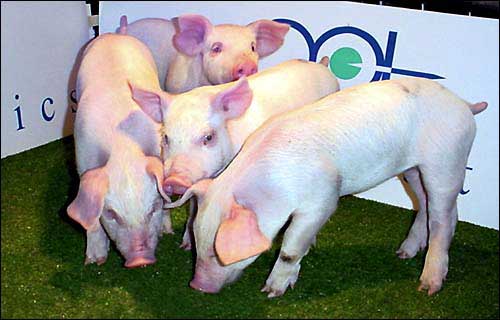
Scientists in Blacksburg, Va., said that these four piglets were cloned lacking both copies of the gene that prompts the human immune system to reject pig tissues, which one day may make pigs a viable source for human replacement organs.
A fifth piglet died shortly after birth of unknown causes, the company said.
In United States, Britain and other countries, organ failure is the major cause of death and disability and except for the kidney the only treatment is transplantation. Because of the shortage of human organs, a fraction of people who need transplants get them, and many die while waiting.
In the United States, more than 80,000 people are awaiting an organ transplant. Last year, about 24,000 transplants were performed and 6,000 people died waiting for their operations.
“Developing another source of organs would have a profound impact on society, so from a practical perspective this is a very important advance,” said Dr. Jeffrey L. Platt, head of transplantation biology at the Mayo Clinic in Rochester, Minn. “And even if it doesn’t solve the problem, it will answer very important questions in the field.”
In January, PPL Therapeutics and competitor Immerge BioTherapeutics both said they had created pigs that lack one of the two copies of the critical gene, called the GGTA1 gene. That step proved that the science was possible.
The GGTA1 gene makes a sugar called alpha-1-galactose, which lines pig blood vessels. Because it is nearly identical to a bacterial sugar, the human immune system attacks it. Pig organs transplanted into people would be destroyed almost instantly.
“People believe that the difference between the human heart, which doesn’t have the sugar, and the pig’s heart, which does, is an evolutionary process,” said Geoff Cook, chief executive officer of PPL Therapeutics.
Cook predicted that studies testing pig organs in humans could start within two years two years sooner than predicted earlier this year before the double knockout experiment.
The next step is to transplant pig organs into other animals, such as baboons.