

Bush: Logging would help cut fires
Ruch, Ore. ? President Bush, on a mountain peak blighted by wildfire, crumbled the dead black bark of a Douglas fir in his palm and challenged environmentalist critics of his new forest initiatives: “Come and stand where I stand.”
The president proposed Thursday to end the government’s “hands-off” policy in national forests and make it easier for timber companies to remove wood from 190 million acres of the most highly fire-prone forests. “We need to understand if you let kindling build up and there’s a lightning strike, you’re going get yourself a big fire,” Bush said.
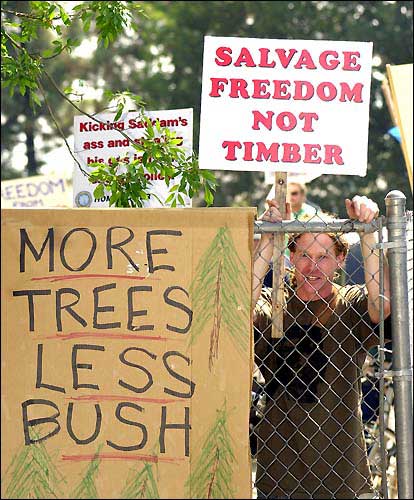
Environmentalist Joe Schwartz stands outside Compton Arena in Central Point, Ore., as he and other protesters gather while President George W. Bush speaks inside. Bush Thursday proposed a plan making it easier for the timber industry to thin national forests.
Environmentalists objected to the president’s forestry plan, saying it would open forests to loggers run amok. And several hundred protesters angrily greeted Bush’s arrival in Portland Thursday evening with just that message.
Outside the downtown hotel where Bush raised money for Sen. Gordon Smith, riot police wielded pepper spray against demonstrators protesting Bush’s forest plan, Iraq policy and more who hammered on police cars and refused orders to clear the area.
Directing Air Force One to fly low and give him a view of the 471,000-acre Biscuit fire blazing in southeastern Oregon, Bush began a three-day Western swing to promote his forest plan and collect more than $5 million for Republican candidates here and in California and New Mexico.
He brushed aside any concern about appearances on the eve of his fund raising with California GOP gubernatorial candidate Bill Simon, who hasn’t seen Bush since the Simon family’s investment firm was dealt a $78 million civil fraud verdict last month.
The president, asked during his forest tour how he reconciled supporting Simon while also calling for zero tolerance of corporate crime, replied that Simon had assured the White House that “when the courts look at this case, he’ll be innocent and I take the man for his word.”
Bush, in cowboy boots, kicked at the ashen soil of Squires Peak, where fire raged across 2,800 acres less than one month ago.
“What the critics need to do is come and stand where I stand,” he said. “We are trying to bring a little common sense to forest policy.”
Firefighter Cody Goodnough, at work looking for embers, told Bush his approach “will make our job easier.”
Only limited forest thinning had been done on Squires because six years of environmental analysis and legal review, 830 pages of documentation, several appeals and two lawsuits tied up all but a fraction of the Bureau of Land Management’s proposed work there.
Bush, who wants to limit reviews and appeals, saw for himself the difference thinning made at Squires Peak: On the side BLM could not get to was a blighted moonscape of dead tree trunks that fell away to black dust in his hand; on the other, surviving trees and regrowth already budding in the ash.
“This is the second fire site I’ve been to this summer and it’s the same story,” Bush said. “Had we properly managed our forests, the devastation caused would not have been nearly as severe as it has been and it’s a crying shame.”
Amy Mall, a forest policy specialist at The Natural Resources Defense Council, and other environmentalists accused Bush of taking this year’s especially bad fire season as an excuse to make more federally grown wood available to timber companies.