

Oklahoma City trying to revamp image
City known as cow town, bombing site spending $1 billion on revitalization
OKLAHOMA CITY ? It’s not just cows, twisters and tumbleweeds sweeping down the plains around here.
The city known mostly for its cattle stockyards, severe storms and the 1995 bombing of the Alfred P. Murrah Federal Building is trying to change its image, taking on one of the most extensive downtown revitalization projects in the country.
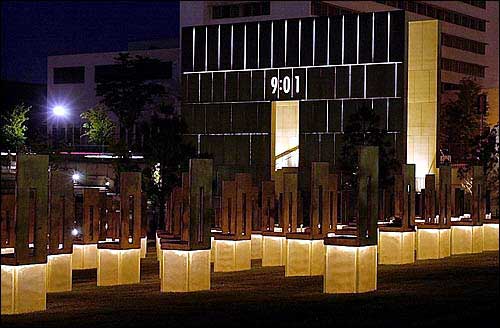
The Oklahoma City National Memorial is one of the top tourist attractions in Oklahoma City. The east entrance gate, right, bears 9:01, the time one minute before the bomb blast on April 19, 1995.
A new entertainment district along a shimmering canal, one of the top minor league ballparks in the nation, and centers for music and art have transformed downtown into a place worth visiting after dark.
Ten years ago, downtown activity died at the end of the business day.
“It was the safest place in town because even criminals wouldn’t come here,” jokes Mayor Kirk Humphreys.
A $390 million revitalization paid for in part through a voter-approved sales tax funded the ballpark, canal, library, 20,000-seat sports arena and the renovation of the convention center and a 1937 art deco music hall.
Soon after, private donors gave $40 million to move the art museum from the fairgrounds to a three-story, limestone building downtown. New hotels and businesses weren’t far behind, bringing the total spent on downtown’s transformation to more than $1 billion.
Now private donors are planning to shell out $275,000 apiece for two green lights that will shoot more than a mile into the sky. The so-called “Beacons of Hope” will stand as a symbolic entryway to downtown.
“Our image in the past has been of a Western city,” Humphreys said. “That’s a part of our heritage, but we think Oklahoma City is much more modern than that, much more diverse than that.”
Other cities are taking notice.
“I was impressed with what I saw,” says Fernando Costa, planning director for Fort Worth, Tex., another city that has revived its downtown. “It’s attractive. It contains a collection of historical buildings. It’s clean, and it gives the appearance of safety. I think it has many assets that can attract investment.”
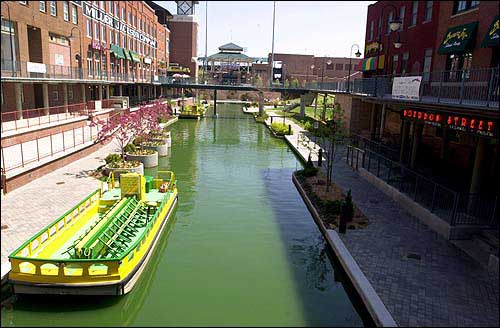
Oklahoma City leaders use the newly constructed river walk area of the city as the focal point for the rebirth of the city. The city is taking on one of the most extensive downtown revitalization projects in the country.
Wake-up call
The push for downtown revitalization came in the early 1990s after Oklahoma City lost its bid for a United Airlines maintenance facility. United officials said Oklahoma City’s quality of life was lacking, and instead went to Indianapolis.
That kicked Oklahoma City leaders into gear.
They’re still working on the shopping, most recently by negotiating with Bass Pro Shops. But restaurants and nightclubs are attracting thousands to downtown.
“I think there’s an optimism that wasn’t here before,” the mayor says. “Other people are starting to notice. We’re not New York. We’re not Chicago. We’re not Dallas. But we are a lot better Oklahoma City.”
City leaders next want to improve downtown neighborhoods, many of which were wiped out by highway construction and suburban migration.
Spaghetti Warehouse was one of the first businesses to see the potential in an improved downtown district. It opened in the abandoned Oklahoma Furniture Co. building in 1989.
Locals were soon calling the district Bricktown because of its red brick streets and buildings.
A decade later, people are dining on patios above the mile-long, $32.1 million Bricktown Canal, taking water taxi rides and standing in line to get inside night clubs.
Old-fashioned red trolleys cruise to many of the tourist attractions in the area. A program called Metropolitan Area Projects (MAPS) bought the city 12 trollies, and the Chamber of Commerce offers 45-minute, $2 tours of the new development.
The tour soundtrack brags about the city’s progress and future growth, such as a 16-screen movie theater coming to the riverfront. It hints that Oklahoma City’s new arena might attract a professional basketball or hockey team.
The “New Century Tour” also visits some historical spots, including Deep Deuce, the city’s historic black neighborhood that once bustled with theater and jazz clubs.
Then it swings by the Capitol, where workers are constructing a dome that will double the building’s height, and supporters say, improve the state’s self-image.
The area around the Capitol, once plagued by seedy motels, is getting a boost. The Legislature has allocated money to line Lincoln Boulevard with trees, street lighting and improved office buildings.
The Chamber of Commerce’s image campaign isn’t aimed just at outsiders; it’s for locals, too.
Overcoming adversity
John Steinbeck portrayed the state as desperate, dusty and treeless in “The Grapes of Wrath.” There was the oil bust of the late 1980s, and the loss of 168 lives in the 1995 bombing of the federal building.
Seven years later, the city is struggling to move beyond the bombing. A museum and memorial dedicated to the tragedy is one of the most popular tourist attractions, and often the only place travelers actually visit when they get off the Interstate.
Chamber officials are trying to fix that.
“We’re not just this poor little city in the Midwest that just so happened to have the Murrah Building bombing,” says Jill Nees, the Chamber of Commerce’s manager of public relations and image development. “We’re so much more than that. It’s not like we want to forget the bombing, but there are other things.”
The state Department of Commerce is paying an advertising company $650,000 to improve the state’s image after research showed Oklahoma is perceived as a sparsely populated place where not a lot is happening. The theme for locals is “I believe in Oklahoma,” and for out-of-staters: “Oklahoma: Believing in the American Dream.”
The campaign spotlights several successful Oklahomans.