

U.N. conference to wrestle with elderly population boom
Madrid, Spain ? The predictions are almost cataclysmic: In 50 years, if trends continue, the number of people older than 60 will triple. Those 2 billion seniors would outnumber the world’s youths.
By 2150, one-third of the world’s population would be older than 60.
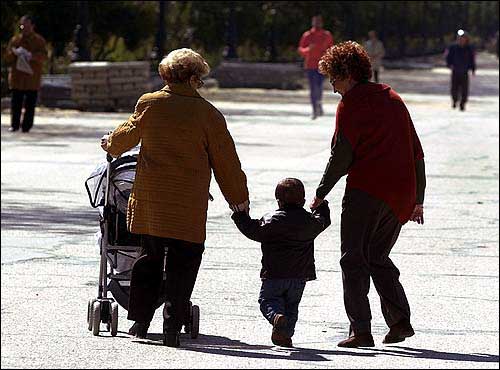
Two elderly women hold hands with a young boy in Retiro Park in Madrid, Spain. A United Nations conference that gets under way Monday in Madrid will look at how to deal with the consequences of the forecast population explosion of elderly people worldwide in the next half-century.
But long before that, gains in longevity could bring a worldwide economic crisis, experts warn. With the population’s proportion of taxpaying workers shrinking, national budgets could be overwhelmed in trying to provide retirement and health benefits for the elderly.
“By the mid-2020s, virtually the entire developed world will be one big Argentina unless some serious reforms are made,” said Paul Hewitt of the Center for Strategic and International Studies in Washington, referring to the economic woes the South American country has suffered in recent months.
So, on Monday, representatives from 160 countries and international organizations begin a five-day United Nations conference in Madrid to grapple with the challenges posed by the graying of humanity.
Developing a plan
The United Nations says older populations will significantly change patterns of “savings, investment and consumption, labor markets, pensions, taxation … health care, family composition and living arrangements, housing and migration.”
In the developing world, the pace of aging is faster than in developed countries, giving the poorest societies less time to cope. The ramifications could be serious as the elderly become an additional burden to the traditional scourges of poverty and disease.


Delegates at the Second World Assembly on Aging the first was 20 years ago in Vienna, Austria will try to agree on an action plan for addressing a host of aging-related issues: retirement age flexibility; living with dependency; elderly benefits; technology and the aging process; death matters such as euthanasia.
The meeting’s chairman, Spanish Labor and Social Affairs Minister Juan Carlos Aparicio, said Wednesday that “60 to 70 percent” of the plan had already been agreed on in preparatory negotiations.
Nevertheless, hundreds of nongovernmental organizations from the AARP in the United States to the Red Cross of Mongolia are having their own meetings this weekend to push for firm commitments.
“We want to ensure there will be clear and comprehensive solutions, not just a magnificent closing ceremony and pledges that two or three years later everybody has forgotten,” said Hector Maravall of the Spanish trade union CCOO.
Third World quandary
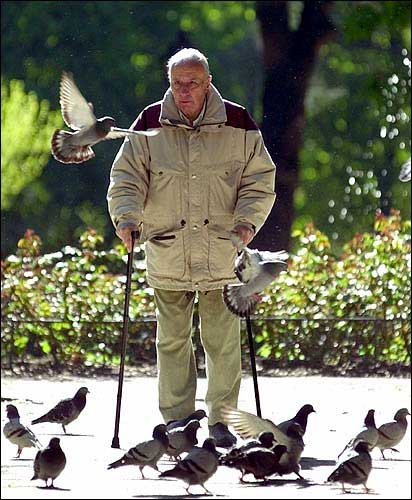
If United Nations forecasts are correct, people older than 60, like 80-year-old Gonzalo Sanesteban, will outnumber the rest of the global population by 2050. Sanesteban was taking his daily walk Thursday through Retiro Park in Madrid, Spain. A U.N. conference on aging gets under way Monday in Madrid.
One of the key issues is aging in developing countries. Now that family planning programs have lowered birth rates, populations are getting older faster than societies can cope, the United Nations says. With limited governmental means to provide for elderly care, the burden is expected to fall on already struggling families.
“In Africa, because of the AIDS epidemic, it is often the grandparents who are taking care of children,” said Eduardo Rodriguez, president of the Spanish Confederation of Elderly Organizations and co-chairman of the non-governmental meeting.
A projected drop in the ratio of working-age people to retirees from the current 9-to-1 to 4-to-1 by 2050 means taxes won’t be able to cover as much of social security costs as they do now, the Center for Strategic and International Studies says.
Governments will have to borrow heavily for retirement payments, and baby boomers will be cashing in savings, reducing the capital available for business investment and pushing up interest rates, a panel of 85 world figures commissioned by the center warns in a report being released at the conference.
Changes on horizon
The panel, which included former U.S. Vice President Walter Mondale and Japanese Prime Minister Ryutaro Hashimoto, said Europe, America and Japan will have to raise minimum ages for retirement considerably and switch to market-based, employer-financed pension plans.
“We’re going to have to convince baby boomers that they didn’t pay for their own benefits, but for their parents,” said Hewitt, the report’s author. “This crisis is going to be a terrible political problem.”
This will particularly be the case in Europe, where faith in the cradle-to-grave welfare state remains fierce. While unions are beginning to accept voluntary retirement at a later age, many Europeans still feel the state should take care of the sick and the elderly, even if it means higher taxes.