Archive for Thursday, November 5, 2009
Soil samples to help save Potter Lake
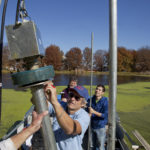
Jerry deNoyelles, deputy director of the Kansas Biological Survey and a professor in the ecology and evolutionary biology department at Kansas University, disassembles a coring unit after taking a core sample from Potter Lake Wednesday, Nov. 4, 2009 at Potter Lake. Both Kansas Biological Survey officials and Kansas University faculty from both the ecology and evolutionary biology department and the environmental studies department worked to extract core samples from the lake to measure sedimentation. In back are KU environmental studies professor Bob Hagen and Lenexa senior Ryan Callihan.
November 5, 2009
Advertisement
Scientists analyze KU's Potter Lake
The Kansas Biological Survey's sediment coring rig visited Potter Lake Wednesday to quantify the amount of sediment and to take material for chemical analysis. The work could help restore the health of the landmark situated in the middle of KU's campus. Enlarge video
Kansas University scientists who travel all over the state gathering data on lakes stayed home on Wednesday conducting research in their backyard.
What they found was enough silt in Potter Lake to fill roughly 600 dump trucks with mud.
A group from the Kansas Biological Survey took soil samples at Potter Lake to determine how much it would cost to dredge the aging pond.
“That’s an awful lot of silt, considering we have a fairly small watershed here,” said Mark Jakubauskas, a research associate professor at the Kansas Biological Survey.
A campus treasure, Potter Lake once hosted canoe races and had diving platforms. In the 1950s, it was drained and dredged. Over the past half century, runoff has washed into the lake, filling it with sediment, nutrients and plant life.
This summer, the lake’s health was at a crisis point. Heavy rainfalls led to a burst in plant growth, which sucked oxygen from the water. As a result, hundreds of fish died.
This fall, student groups joined together to make improvements — scooping out 8 tons of coontail one pitchfork at a time. They also added aerators to increase the lake’s oxygen levels.
It’s time to dredge the lake again, said Jerry deNoyelles, deputy director of the Kansas Biological Survey.
“It is probably the only long-term solution that there is,” he said.
It was a solution that had the scientists building a wooden ramp Wednesday to launch a 24-foot pontoon boat into the one-and-a-half-acre lake.
“We’re in. We are not coming out,” deNoyelles joked as the boat glided into the water.
By using a 15-foot drilling rig called a vibracore — a kind of giant metal straw with a motor on top — the scientists were able to push through the silt to reach the original bottom of the lake and then pull the sediment up in a tube.
More than a half-dozen of these core sediment samples were taken. By noon, the group had enough data to estimate the lake had an average of two feet of sediment on the bottom — a total of 5,000 cubic yards of silt.
Previous student groups have estimated it would cost between $50,000 and $100,000 to dredge the lake.
Along with helping establish the cost of dredging, Wednesday’s sediment collection will be sent to labs to be analyzed. That information will help determine what dredging methods will work best.
And, just in case any former KU students were wondering, the group hadn’t come across any lost car keys, term papers or textbooks. So far, the scientists have pulled up only mud.
More like this
- Students probe Potter Lake 11 comments / May 15, 2008
- Silt crowding out drinking water in reservoirs 27 comments / October 28, 2007
- Sediment growing problem at Clinton 4 comments / September 3, 2006
- Mapping gets to bottom of state's shrinking lakes 17 comments / December 17, 2006
- Future of water supply murky 5 comments / August 22, 2005
Top ads RSS
Marketplace
Arts & Entertainment · Bars · Theatres · Restaurants · Coffeehouses · Libraries · Antiques · Services
- Blog: Palin Book Could Be Your Cheapest Source For Winter Fuel November 20, 2009 · 57 comments
- Mangino denies validity of former player allegations November 19, 2009 · 157 comments
- Blog: We Noticed November 19, 2009 · 115 comments
- Commission votes against including gender identity in Lawrence's anti-discrimination policy November 19, 2009 · 32 comments
- Blog: Why Do People Repeat Falsehoods? November 20, 2009 · 47 comments
- Lawrence man charged in hit-and-run accident that killed bicyclist November 19, 2009 · 109 comments
- Muslim countries seek blasphemy ban November 20, 2009 · 26 comments
- Not-so-gentle reign November 19, 2009 · 133 comments
- KU's Chancellor issues statement putting support behind Lew Perkins November 20, 2009 · 36 comments
- Poll: How much are you contributing to the United Way this year? November 21, 2009 · 1 comment
- Farmers' Turnpike reopens after four months of construction November 20, 2009
- KU's Chancellor issues statement putting support behind Lew Perkins November 20, 2009
- Commission votes against including gender identity in Lawrence's anti-discrimination policy November 19, 2009
- Tonganoxie child, 2, making remarkable recovery after traumatic accident November 18, 2009
- New, legal, drug has law enforcement concerned — and it's already on a Lawrence store's shelves November 4, 2009
- Phillips County businesses create own hamburger October 2, 2003
- CLARENCE E. RINKE OBITUARY October 19, 1999
- Resident hopes to start rickshaw business in downtown Lawrence, pending city approval November 19, 2009
- KU student pushes button that demolishes a portion of the Kansas Turnpike bridge November 19, 2009
- Salvation Army has high hopes for Red Kettle campaign, despite slow start November 20, 2009


5 November 2009
at 7:41 a.m.
Suggest removal
Permalink
consumer1 (Anonymous) says…
Hey now, the idea is for the lake to become solid so the university can use that wasted space. I do find it rather amusing though. The article says “the heavy rains led to a burst in plant growth, which sucked oxygen from the water. As a result, hundreds of fish died”. What I wonder about is this, (and yes I am about to start a fight). How do the grounds people keep that grass looking so pretty and weed free throughout the year? Hmmm?? Could the chemicals they use be the real perpetraitor here? Run off into the lake causing the feeding of plants in the water to experience rapid growth? While at the same time poisoning the fish in the water? Just curiuos.
5 November 2009
at 7:45 a.m.
Suggest removal
Permalink
tumbilweed (Anonymous) says…
This is what ponds do.
5 November 2009
at 8:16 a.m.
Suggest removal
Permalink
edjayhawk (Anonymous) says…
Consumer, if you don't have anything logical or positive to say then don't say anything at all. I'm sick of all of your negative posts on every topic this morning…Then again you probably don't have a real life like most losers in Lawrence.
5 November 2009
at 9:06 a.m.
Suggest removal
Permalink
jazzttt (Anonymous) says…
Had a humorous flashback while reading this, it took me back to my mid-'60s days as a KU student, when conventional campus wisdom held that Potter Lake was the only rubber-lined lake in Kansas. Seeing as how students will be students, perhaps a 50-year thick layer of discarded latex rubber on the botom has inhibited natural biodegradation. Seriously, that's a LOT of sediment, what happens when old Snow Hall and Carruth-O'Leary fall into the lake due to the soil around their foundations washing away? Perhaps the creation of some kind of small catch basin where the sediment could be periodically scooped out before winding up in the lake would help, but I'm not a hydrological engineer.
5 November 2009
at 9:36 a.m.
Suggest removal
Permalink
consumer1 (Anonymous) says…
Edhayhack, You are soooooo easy. I do this just to mess with fragile psuedo intellects like yourself. Ha ha,
Have a great day. YOu are way too uptight. And guess what you cannot tell me what to do, when to do it or not do it. So, it must suck to be so easily stressed out. Too funny.
5 November 2009
at 9:37 a.m.
Suggest removal
Permalink
consumer1 (Anonymous) says…
Edhayhack, You are soooooo easy. I do this just to mess with fragile psuedo intellects like yourself. Ha ha,
Have a great day. YOu are way too uptight. And guess what you cannot tell me what to do, when to do it or not do it. So, it must suck to be so easily stressed out. Too funny
5 November 2009
at 11:02 a.m.
Suggest removal
Permalink
dudedog12 (Anonymous) says…
Be green, put some asian carp in it , they'll not only eat all of the plant life, but also repopulate.
5 November 2009
at 11:14 a.m.
Suggest removal
Permalink
puddleglum (Anonymous) says…
dudedog,
are you saying asians can't drive? or that they are all vegetarians? or that they are taking over the population of the world?
this is so racialististic.
5 November 2009
at 11:34 a.m.
Suggest removal
Permalink
lounger (Anonymous) says…
consumer 1 is correct-like it or not. K.U. puts waaaay to much chemical fertilizer on the grounds near the lake. This is major issue that would improve things right away if they were more sensitive to potters lake. Actually K.U. puts waaay to much chemical fertilizer on everything! Go green K.U. its about time!!!!
5 November 2009
at 11:53 a.m.
Suggest removal
Permalink
Pogo (Anonymous) says…
Howz about the rich athletic types doing something decent and fund the process of saving this treasure. Self, Mangino, and Perkins alone wouldn't miss the money; and while we're at it, howz about the rich/wealthy KU “administrators” and “professors” along with their buddies at both the endownment operation and the “alumnae' outfit cutting their mail bill; stop sending requests to become a “member”; and use the money to save the lake??
Disclaimer: These “eraser” sharp observations and deductions may be illusory,hallucinatory, the product of a profligate delusional husk, a Mekong and Guaro riddled wastrel,and a mere cut above those available in the New York Times.
5 November 2009
at 11:55 a.m.
Suggest removal
Permalink
notjustastudent (Anonymous) says…
KU has been fertilizing for years and years, but the plant boom did not happen for years and years, it happened this year, when we had ridiculous amounts of rain. Logic tells us that it isn't the fertilizers, it's the rain. Extra silt is not a result of fertilizers. Science also tells us this, but I'm not a scientist so I'll go with what I know (logic) and point out that fertilizers help things grow, they have root systems, root systems hold soil in place, so silt would be less likely a result from over fertilizing, and more likely a result from (get this) the runoff that results from too much rain. Still, it wouldn't hurt for KU to be greener…
Dudedog- some of the fish that died were the carp they put in last spring to eat the grass.
Puddle- I hope you're being sarcastic, and if you are, thanks for making me laugh today. Well done!
5 November 2009
at 12:07 p.m.
Suggest removal
Permalink
Irish (Irish Swearingen) says…
I enjoyed seeing the pictures of Potter Lake as it has been in the past.
I remember when they had ducks swimming out there and families would throw bread into the water for them and the fish.
5 November 2009
at 12:28 p.m.
Suggest removal
Permalink
autie (Anonymous) says…
Wow, Jerry looks so different now. He must have gotten older or something since I had him as a teacher. Like 32 years older.
5 November 2009
at 12:32 p.m.
Suggest removal
Permalink
jimmyjms (Anonymous) says…
Nah, deNoyelles could pass for 50 any day.
5 November 2009
at 1:07 p.m.
Suggest removal
Permalink
consumer1 (Anonymous) says…
It seemed logical to me, but hey? I am not a horticulterist (sp) not even sure if i spelled it right. It would seem logical to me that chemicals would somehow bind with the particles of ground they need and reject the rest, causing the unwanted or Unbound to release and wash off. That washoff could consist of the chemical that are unabsorbed by the root system. you can only fill a quart jug with a quart of anyting right? everything you try to put into it after is is full spills out.??? I am just saying… stands to reason to me that would cause abnormal growth around the waters edge and further as it leaches furhter into the water. also killing fish and snow boarders who happen to break through the ice while sledding.
5 November 2009
at 1:28 p.m.
Suggest removal
Permalink
dudedog12 (Anonymous) says…
PG, if you knew anything about fish, you would know that there is such a thing as grass eatting carp for the purpose of cleaning up water bodies. I have them in my pond on the farm.
5 November 2009
at 8:41 p.m.
Suggest removal
Permalink
3up3down (Anonymous) says…
I like all the old pictures as well. One problem though. They are missing the one picture that was the best. It was the cadaver taken from Snow Hall, propped up under a tree with sunglasses and a newpaper. Got to love those students and their sense of humor.