De Soto couple makes, sells airboats for science, rescue and fires
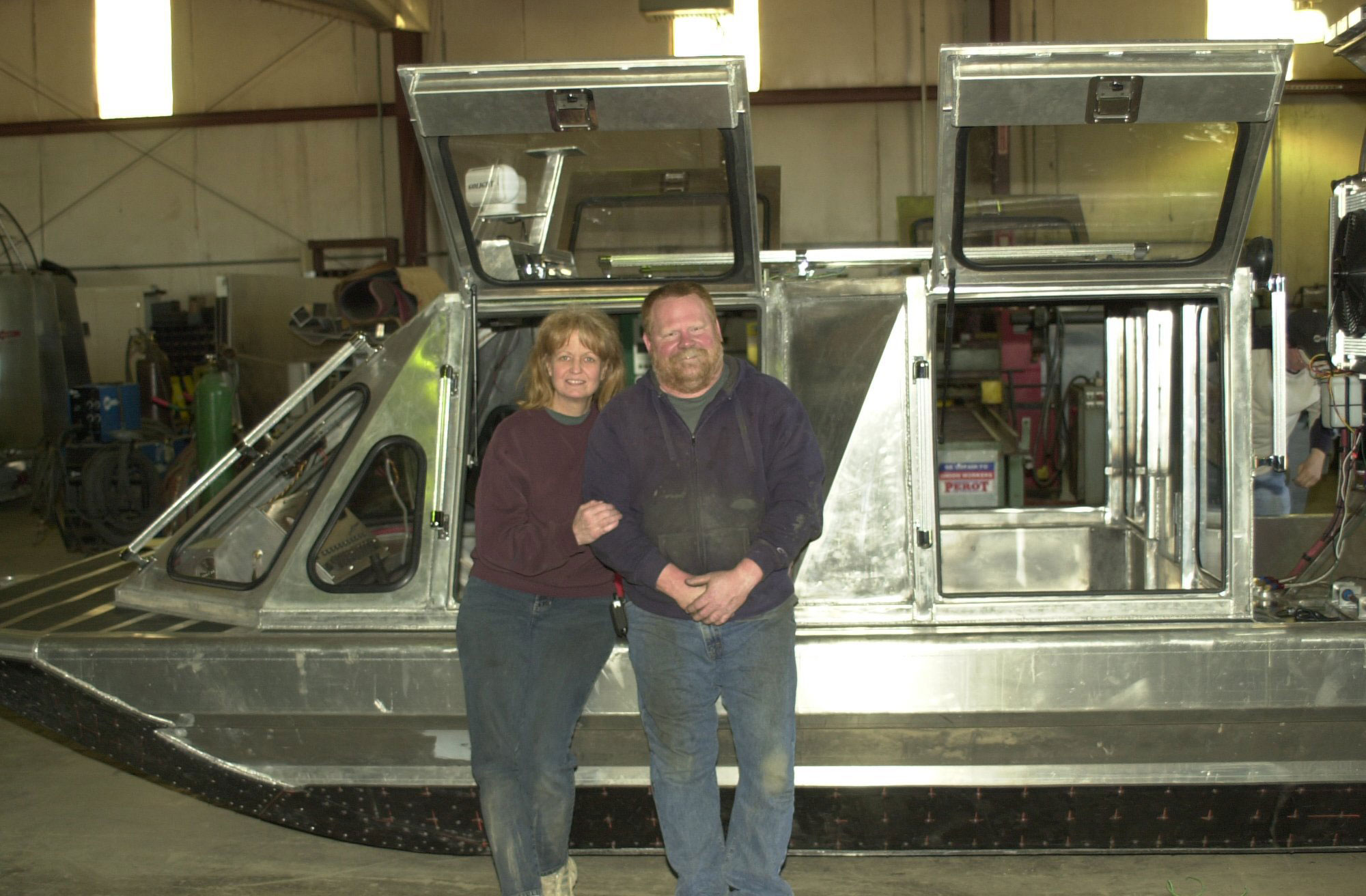
Matthew and Cathy Cain are finishing their first airboat ambulance they sold to the city of Grosse Ile, Mich.
De Soto ? For years, Cathy and Matthew Cain had a local reputation as the couple to call when emergency responders needed help on the Kansas River.
“We responded quite a few times,” Matthew said. “Even years ago, I’d get phone calls to go look for people because fire departments couldn’t do it.”
What the Cains had that emergency responders didn’t was an airboat, or shallow-draft craft pushed by a rear-mounted propeller, that could easily navigate parts of the Kaw too shallow for traditional craft.
Matthew started making airboats for his own recreational use on the Kansas River more than a decade ago. The Eudora couple’s interest was such that he is president and she is the secretary of the Kaw Valley Air Boaters Association.
Those rescue calls eventually made Matthew wonder if there might be an opportunity to make and market airboat rescue craft. With a little research, he learned available rescue airboats were little more than traditional recreation craft with a windshield on the front and a canvas cabin hung behind the controls.
Two years ago, the Cains decided they could do better.
“The last couple of years has been a lot of trial and error before we arrived at a point we were ready to go into the open market,” Matthew said.
‘All the comforts of home’
The Cains developed airboat models with polymer-coated aluminum hulls and reinforced with braces to cut through icy rivers and lakes. The boats, sold through their business, Rescue Master Airboats Inc., also have fully enclosed, heated aluminum cabins.
“All the comforts of home,” Cathy said.
The enclosed cabin also protects the airboats from swamping in rough water, which is a problem with traditional craft, Matthew said.
The first order came from Kansas Biological Survey near the start of the trial-and-error period in fall of 2005. Jim Thorpe, a Kansas University professor and senior scientist with the survey, said the airboat enters its second and more intense summer of service this year.
“We use it for two purposes,” he said. “One is when we are working on Plains rivers like the Kansas River with sand beds. The Arkansas and Platte, many parts of the rivers need an airboat to operate. We also use it on some sections of reservoirs, wetlands or any shallow environment.
“We’re really happy with the boat. I think they are the best kind of airboat that you can get in the country by far.”
Nationwide interest
The second order was for a larger Ambulance Master, which has room to carry and treat two patients. Also on the drawing board is a Fire Master that will be equipped to pump water on fires and a Dive Master for underwater searches.
The Grosse Ile, Mich., Fire Department ordered the first $160,000 Ambulance Master for use on the Detroit River and Lake Erie. The Cains said they received the order after placing an advertisement in a fire and rescue trade magazine.
“They were looking for a rescue airboat but weren’t satisfied with what was out there,” he said. “When they saw that advertisement, they decided this was what they wanted.”
A Web site and word of mouth from a demonstration on Michigan’s Saginaw River also have created interest. In the February 2006 demonstration, the Cains’ airboat proved its superiority to rescue airboats with fiberglass or composite hulls that couldn’t stand up to the punishment of breaking through ice or the effect of “ice channeling,” when the parted ice presses on the sides of the hull, Matthew said.
“There were about 4 inches of ice on the river,” he said. “This boat broke the ice and survived the channeling. They were very impressed.”
“So were we,” Cathy said. “We’d never seen that much ice before.”
That demonstration, a Web site and their advertisements have drummed up interest from fire departments and emergency medical services in the northern United States and Canada, the couple said.
“We thought the military would be our big client, but it looks like it’s going to be fire departments,” Matthew said. “Since the ad appeared in the magazine, we’ve had about 700 requests for information.”
Power of a hurricane
Building an airboat strong enough to break through 4 inches of ice is a labor-intensive process. The Cains said it takes them and employee Randy Canaan, De Soto, about 10 weeks to build a boat. They have jigs for the hull, cabin and propeller cage, but structural pieces that reinforce the hull have to be handcrafted.
“We don’t want to go with a cookie-cutter type of thing,” Cathy said. “We want to deliver a good product.”
The term “airboat” sells the craft short. The powerful push from the ambulance’s 572-cubic-inch, 620 horsepower motor allows the 4,000-pound craft to operate on ice, snow, wet sand and even pavement. It can move the boat over water at 50 mph, Matthew said.
“There’s a hurricane-force wind coming off the back of that thing, so you don’t want to stand behind it,” he said.
The boats are now built in a shop the couple lease from Dave Penny in De Soto’s East Bottoms, but the Cains said they would have to relocate to a bigger facility in time. The uniqueness of their product has them optimistic about the future, even if others decide to copy their success.
“I figure we’ve got a head start in experience and design,” Matthew said. “We’ve done a pretty good job of getting our name out there.”
City Government

Lawrence Transit’s sales tax is ‘critical,’ its director says, and an increase could be on the ballot in November
New question arises around Rock Chalk Park trails: Why are nearly 2 miles of them missing?

City of Lawrence enters negotiations with a city manager candidate; announcement could come next week
Lawrence Outdoor Aquatic Center’s opening delayed until June 1 as renovation work continues
Part of soccer photo collage at Lawrence City Hall was pulled down during storm, but city says it will be back up soon