Practicing for the unpredictable
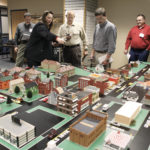
Local law enforcement employees respond to simulated emergencies using a model campus at Kansas University. Sgt. Darcy Nichols-Curtiss, third from left, from the KU Med Center, instructs public safety officers from the Lawrence campus, Sgt. Gary Wieden, center, and Sgt. Bobby Williams, third from right, on specific areas to quarantine.
Emergency simulation
It was a test. It was only a test.
Kansas University is the latest school to go through critical incident training. Administrators, safety officers and campus and Lawrence police departments took a three-day training session that ended Thursday with a simulation occurring on a small-scale city.
“We do hands-on scenarios with a three-dimensional model city to cue in some visual acuity with them and make it a little bit more realistic,” said Donald Gjestson, a critical incident instructor and a police officer at the University of Wisconsin-Stout.
Two participants were selected to be in the room with the model city, and the rest of the crew had to handle the situation from a command center without a visual. The pressure was on.
“I think the heart rate’s up a bit,” said Capt. Schuyler Bailey of KU Public Safety. “They’re starting to kind of ramp us up a bit. Little problems are popping up, but it’s all designed to test your decision-making skills.”
The critical incident scenario started with an anti-war protest on campus. Members of the Reserve Officers’ Training Corps showed up, and both groups were demanding equal protest space. The commanders with the model led the situation and had to keep the rest of the group aware of what was happening in the field. Then instructors added layers to the scenario, like someone fainting on scene.
“You ask anybody that’s been on the board and they were there. They were on the scene. It was a realistic as possible. They will be sweating,” Gjestson said.
And they’re not the only ones.
“Very stressful,” Bailey said. “Got a lot of information coming at you from several different directions.”
The simulation lasted about three hours and used the real date and weather conditions. The command center even had to incorporate a news conference after “the media” showed up at the demonstration scene.
The International Association of College Law Enforcement Administrators offers the program to universities and colleges around the nation. The group received a grant from the U.S. Department of Homeland Security to fund the project.
“The training went through a lot of municipal police departments and state and federal police departments, but we wanted to bring it to the university so we have a plan,” Gjestson said.
Participants think the program is a great way to practice for the real thing.
“I think what we’re doing is going to better prepare our supervisors and us when this happens in the middle of the night or at noon or whenever,” Bailey said. “It’s going to better prepare them to say, ‘Okay, I can do this.'”
Public Safety
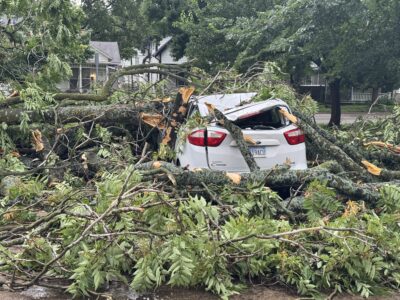
Overnight storm produces some damage in Lawrence, as high winds down dozens of trees
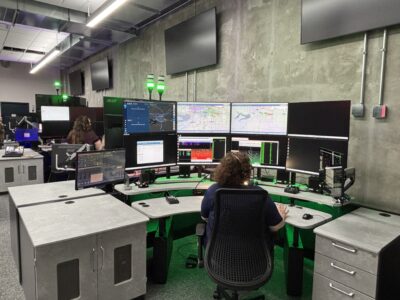
Douglas County emergency response agencies move into new Public Safety Building; Sheriff’s Office coming in July
Grand jury indicts Tonganoxie man accused of threatening to kill someone, child pornography crimes

Indiana man charged with child sex crime from 2001 in Douglas County
At preliminary hearing, man describes being shot by girlfriend’s ex; defendant told police it was self-defense